PDF Publication Title:
Text from PDF Page: 130
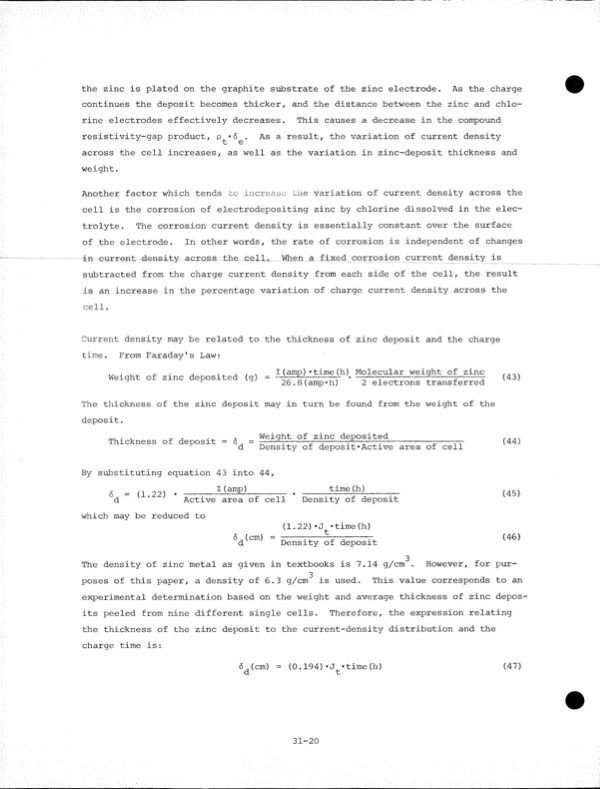
the zinc is plated on the graphite substrate of the zinc electrode. As the charge continues the deposit becomes thicker, and the distance between the zinc and chlo rine electrodes effectively decreases. This causes a decrease in the compound resistivity-gap product, p *6e. As a result, the variation of current density across the cell increases, as well as the variation in zinc-deposit thickness and weight. Anotherfactorwhichtendsto increase thevariationofcurrentdensityacrossthe cell is the corrosion of electrodepositing zinc by chlorine dissolved in the elec trolyte. The corrosion current density is essentially constant over the surface of the electrode. In other words, the rate of corrosion is independent of changes in current density across the cell. When a fixed corrosion current density is subtracted from the charge current density from each side of the cell, the result is an increase in the percentage variation of charge current density across the cell. Current density may be related to the thickness of zinc deposit and the charge time. FromFaraday'sLaw: Weight of zinc deposited (g) I(amp)‘time(h) Molecular weight of zinc 26.8(amp*h) 2 electrons transferred The thickness of the zinc deposit may in turn be found from the weight of the deposit. Thickness of deposit Weight of zinc deposited_______ (44) Density of deposit'Active area of cell By substituting equation 43 into 44, 6 = (1 22) • I (amp)________ # time (h) d " Active area of cell Density of deposit which may be reduced to (1.22)•J •time(h) <5^(cm) Density of deposit 3 The density of zinc metal as given in textbooks is 7.14 g/cm . 3 (45) (46) However, for pur- poses of this paper, a density of 6.3 g/cm is used. This value corresponds to an experimental determination based on the weight and average thickness of zinc depos its peeled from nine different single cells. Therefore, the expression relating the thickness of the zinc deposit to the current-density distribution and the charge time is: 6,(cm) = (0.194)*J •time(h) (47) dt 31-20PDF Image | Development of the Zinc-Chlorine Battery for Utility
PDF Search Title:
Development of the Zinc-Chlorine Battery for UtilityOriginal File Name Searched:
6302789.pdfDIY PDF Search: Google It | Yahoo | Bing
Salgenx Redox Flow Battery Technology: Power up your energy storage game with Salgenx Salt Water Battery. With its advanced technology, the flow battery provides reliable, scalable, and sustainable energy storage for utility-scale projects. Upgrade to a Salgenx flow battery today and take control of your energy future.
CONTACT TEL: 608-238-6001 Email: greg@salgenx.com (Standard Web Page)