
PDF Publication Title:
Text from PDF Page: 132
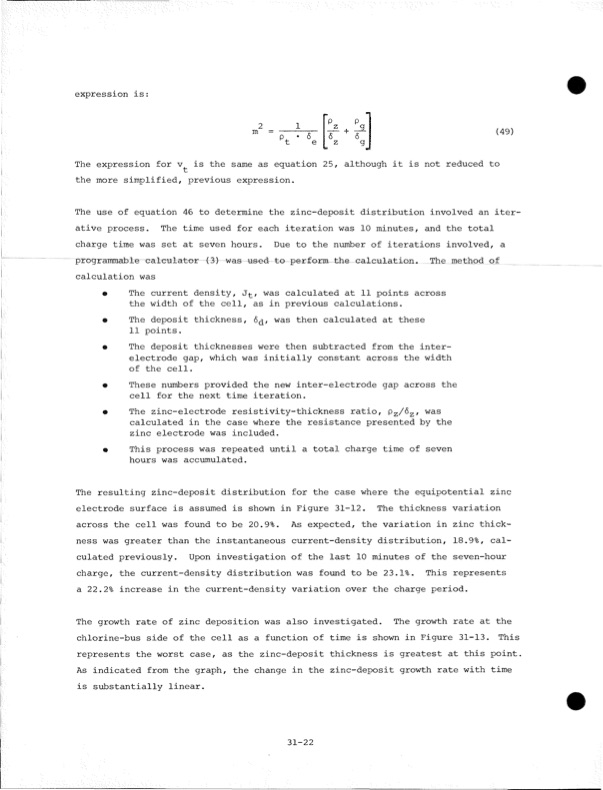
expression is: The expression for v is the same as equation 25, although it is not reduced to the more simplified, previous expression. The use of equation 46 to determine the zinc-deposit distribution involved an iter ative process. The time used for each iteration was 10 minutes, and the total charge time was set at seven hours. Due to the number of iterations involved, a programmablecalculator {3} was used to perform the calculation. The method of calculation was • The current density, J^-, was calculated at 11 points across the width of the cell, as in previous calculations. • The deposit thickness, 63, was then calculated at these 11 points. • The deposit thicknesses were then subtracted from the inter electrode gap, which was initially constant across the width of the cell. • These numbers provided the new inter-electrode gap across the cell for the next time iteration. • The zinc-electrode resistivity-thickness ratio, PZ/<5Z, was calculated in the case where the resistance presented by the zinc electrode was included. • This process was repeated until a total charge time of seven hours was accumulated. The resulting zinc-deposit distribution for the case where the equipotential zinc electrode surface is assumed is shown in Figure 31-12. The thickness variation across the cell was found to be 20.9%. As expected, the variation in zinc thick ness was greater than the instantaneous current-density distribution, 18.9%, cal culated previously. Upon investigation of the last 10 minutes of the seven-hour charge, the current-density distribution was found to be 23.1%. This represents a 22.2% increase in the current-density variation over the charge period. The growth rate of zinc deposition was also investigated. The growth rate at the chlorine-bus side of the cell as a function of time is shown in Figure 31-13. This represents the worst case, as the zinc-deposit thickness is greatest at this point. As indicated from the graph, the change in the zinc-deposit growth rate with time is substantially linear. 31-22PDF Image | Development of the Zinc-Chlorine Battery for Utility
PDF Search Title:
Development of the Zinc-Chlorine Battery for UtilityOriginal File Name Searched:
6302789.pdfDIY PDF Search: Google It | Yahoo | Bing
Salgenx Redox Flow Battery Technology: Power up your energy storage game with Salgenx Salt Water Battery. With its advanced technology, the flow battery provides reliable, scalable, and sustainable energy storage for utility-scale projects. Upgrade to a Salgenx flow battery today and take control of your energy future.
| CONTACT TEL: 608-238-6001 Email: greg@salgenx.com | RSS | AMP |