PDF Publication Title:
Text from PDF Page: 136
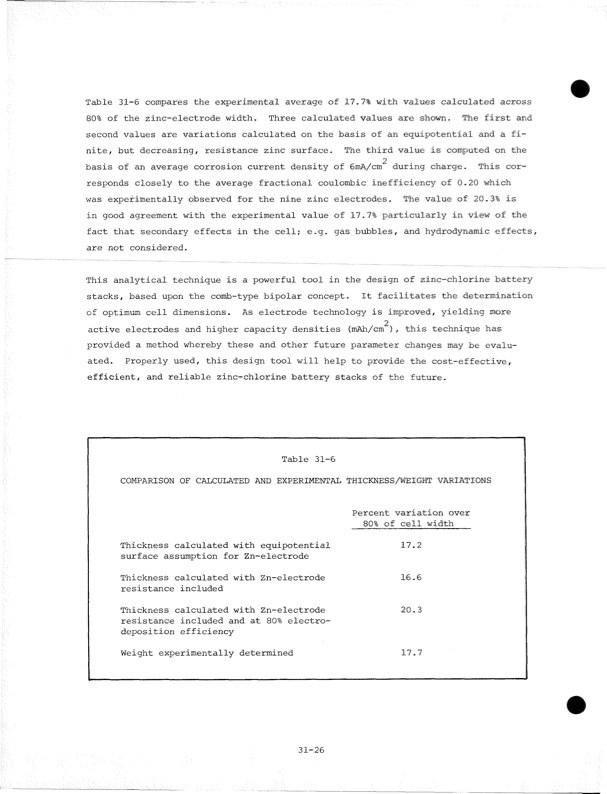
Table 31-6 compares the experimental average of 17.7% with values calculated across 80% of the zinc-electrode width. Three calculated values are shown. The first and second values are variations calculated on the basis of an equipotential and a fi nite, but decreasing, resistance zinc surface. The third value is computed on the 2 basis of an average corrosion current density of 6mA/cm during charge. This cor responds closely to the average fractional coulombic inefficiency of 0.20 which was experimentally observed for the nine zinc electrodes. The value of 20.3% is in good agreement with the experimental value of 17.7% particularly in view of the fact that secondary effects in the cell; e.g. gas bubbles, and hydrodynamic effects, are not considered. This analytical technique is a powerful tool in the design of zinc-chlorine battery stacks, based upon the comb-type bipolar concept. It facilitates the determination of optimum cell dimensions. As electrode technology is improved, yielding more 2 active electrodes and higher capacity densities (mAh/cm ), this technique has provided a method whereby these and other future parameter changes may be evalu ated. Properly used, this design tool will help to provide the cost-effective, efficient, and reliable zinc-chlorine battery stacks of the future. Table 31-6 COMPARISON OF CALCULATED AND EXPERIMENTAL THICKNESS/WEIGHT VARIATIONS Percent variation over 80% of cell width Thickness calculated with equipotential 17.2 surface assumption for Zn-electrode Thickness calculated with Zn-electrode 16.6 resistance included Thickness calculated with Zn-electrode 20.3 resistance included and at 80% electro deposition efficiency Weight experimentally determined 17.7 31-26PDF Image | Development of the Zinc-Chlorine Battery for Utility
PDF Search Title:
Development of the Zinc-Chlorine Battery for UtilityOriginal File Name Searched:
6302789.pdfDIY PDF Search: Google It | Yahoo | Bing
Salgenx Redox Flow Battery Technology: Power up your energy storage game with Salgenx Salt Water Battery. With its advanced technology, the flow battery provides reliable, scalable, and sustainable energy storage for utility-scale projects. Upgrade to a Salgenx flow battery today and take control of your energy future.
CONTACT TEL: 608-238-6001 Email: greg@salgenx.com (Standard Web Page)