PDF Publication Title:
Text from PDF Page: 180
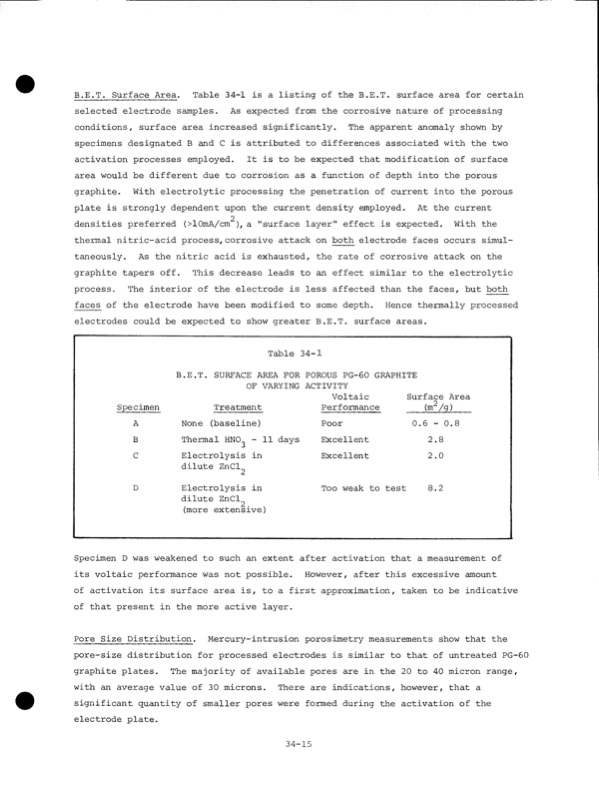
B.E.T. Surface Area. Table 34-1 is a listing of the B.E.T. surface area for certain selected electrode samples. As expected from the corrosive nature of processing conditions, surface area increased significantly. The apparent anomaly shown by specimens designated B and C is attributed to differences associated with the two activation processes employed. It is to be expected that modification of surface area would be different due to corrosion as a function of depth into the porous graphite. With electrolytic processing the penetration of current into the porous plate is strongly dependent upon the current density employed. At the current 2 densities preferred (>10mA/cm ), a "surface layer" effect is expected. With the thermal nitric-acid process, corrosive attack on both electrode faces occurs simul taneously. As the nitric acid is exhausted, the rate of corrosive attack on the graphite tapers off. This decrease leads to an effect similar to the electrolytic process. The interior of the electrode is less affected than the faces, but both faces of the electrode have been modified to some depth. Hence thermally processed electrodes could be expected to show greater B.E.T. surface areas. Specimen A B C D Treatment None (baseline) Thermal HNO^ - 11 days Electrolysis in dilute ZnCl 2 Electrolysis in dilute ZnCl^ (more extensive) Voltaic Performance Poor Excellent Excellent Too weak to test Surface Area (mVg) 0.6 - 0.8 2.8 2.0 8.2 Table 34-1 B.E.T. SURFACE AREA FOR POROUS PG-60 GRAPHITE OF VARYING ACTIVITY Specimen D was weakened to such an extent after activation that a measurement of its voltaic performance was not possible. However, after this excessive amount of activation its surface area is, to a first approximation, taken to be indicative of that present in the more active layer. Pore Size Distribution. Mercury-intrusion porosimetry measurements show that the pore-size distribution for processed electrodes is similar to that of untreated PG-60 graphite plates. The majority of available pores are in the 20 to 40 micron range, with an average value of 30 microns. There are indications, however, that a significant quantity of smaller pores were formed during the activation of the electrode plate. 34-15PDF Image | Development of the Zinc-Chlorine Battery for Utility
PDF Search Title:
Development of the Zinc-Chlorine Battery for UtilityOriginal File Name Searched:
6302789.pdfDIY PDF Search: Google It | Yahoo | Bing
Salgenx Redox Flow Battery Technology: Power up your energy storage game with Salgenx Salt Water Battery. With its advanced technology, the flow battery provides reliable, scalable, and sustainable energy storage for utility-scale projects. Upgrade to a Salgenx flow battery today and take control of your energy future.
| CONTACT TEL: 608-238-6001 Email: greg@salgenx.com | RSS | AMP |