PDF Publication Title:
Text from PDF Page: 195
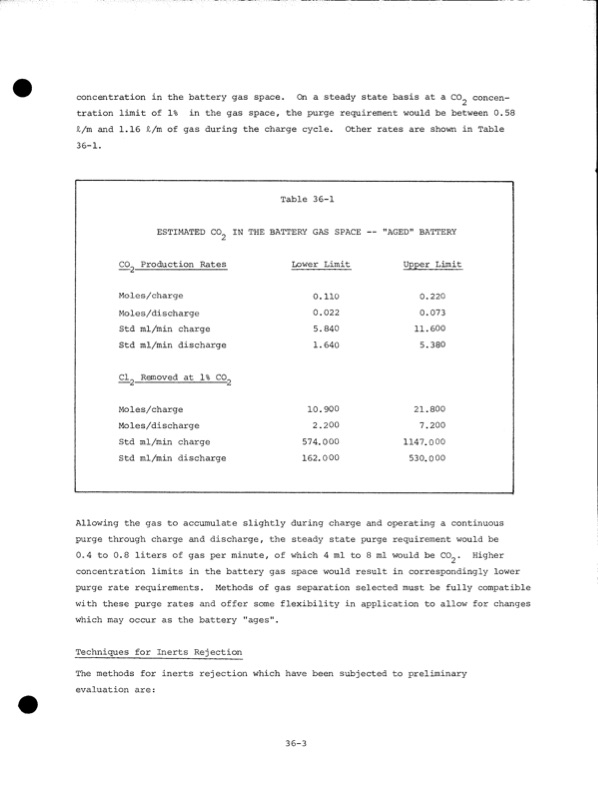
concentration in the battery gas space. On a steady state basis at a C02 concen tration limit of 1% in the gas space, the purge requirement would be between 0.58 £/m and 1.16 Jl/m of gas during the charge cycle. Other rates are shown in Table 36-1. Table 36-1 ESTIMATED CC>2 IN THE BATTERY GAS SPACE — "AGED" BATTERY CO^ Production Rates Moles/charge Moles/discharge Std ml/min charge Std ml/min discharge Cl„ Removed at 1% CCU Moles/charge Moles/discharge Std ml/min charge Std ml/min discharge Lower Limit 0.110 0.022 5.840 1.640 10.900 2.200 574.000 162.000 Upper Limit 0.220 0.073 11.600 5.380 21.800 7.200 1147.000 530.000 Allowing the gas to accumulate slightly during charge and operating a continuous purge through charge and discharge, the steady state purge requirement would be 0.4 to 0.8 liters of gas per minute, of which 4 ml to 8 ml would be C02. Higher concentration limits in the battery gas space would result in correspondingly lower purge rate requirements. Methods of gas separation selected must be fully compatible with these purge rates and offer some flexibility in application to allow for changes which may occur as the battery "ages". Techniques for Inerts Rejection The methods for inerts rejection which have been subjected to preliminary evaluation are: 36-3PDF Image | Development of the Zinc-Chlorine Battery for Utility
PDF Search Title:
Development of the Zinc-Chlorine Battery for UtilityOriginal File Name Searched:
6302789.pdfDIY PDF Search: Google It | Yahoo | Bing
Salgenx Redox Flow Battery Technology: Power up your energy storage game with Salgenx Salt Water Battery. With its advanced technology, the flow battery provides reliable, scalable, and sustainable energy storage for utility-scale projects. Upgrade to a Salgenx flow battery today and take control of your energy future.
CONTACT TEL: 608-238-6001 Email: greg@salgenx.com (Standard Web Page)