PDF Publication Title:
Text from PDF Page: 204
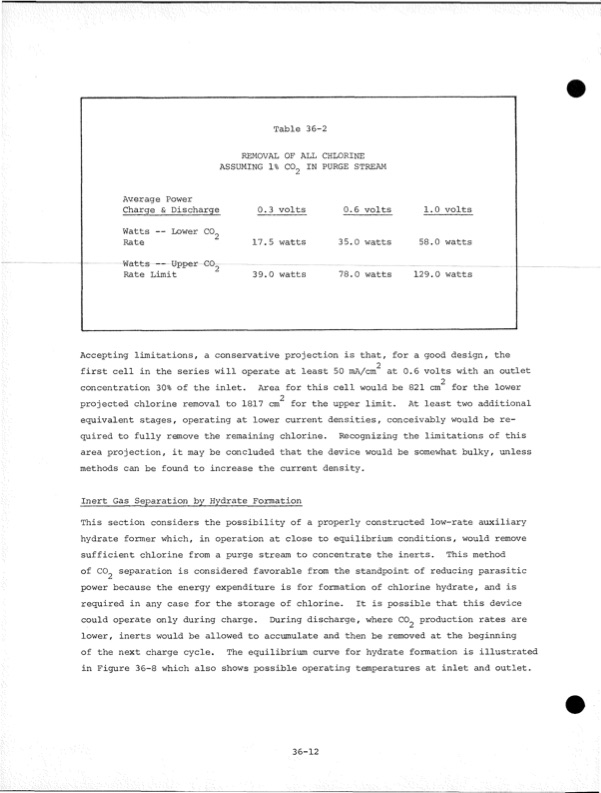
Average Power Charge & Discharge Watts — Lower CO Rate Watts — Upper GO- Rate Limit 0.3volts 17.5 watts .... 39.0 watts 0.6 volts 35.0 watts 78.0 watts 1.0volts 58.0 watts Table 36-2 REMOVAL OF ALL CHLORINE ASSUMING 1% C02 IN PURGE STREAM Accepting limitations, a conservative projection is that, for a good design, the 2 first cell in the series will operate at least 50 mA/cm at 0.6 volts with an outlet 2 concentration 30% of the inlet. Area for this cell would be 821 cm for the lower 2 projected chlorine removal to 1817 cm for the upper limit. At least two additional equivalent stages, operating at lower current densities, conceivably would be re quired to fully remove the remaining chlorine. Recognizing the limitations of this area projection, it may be concluded that the device would be somewhat bulky, unless methods can be found to increase the current density. Inert Gas Separation by Hydrate Formation This section considers the possibility of a properly constructed low-rate auxiliary hydrate former which, in operation at close to equilibrium conditions, would remove sufficient chlorine from a purge stream to concentrate the inerts. This method of C02 separation is considered favorable from the standpoint of reducing parasitic power because the energy expenditure is for formation of chlorine hydrate, and is required in any case for the storage of chlorine. It is possible that this device could operate only during charge. During discharge, where CC>2 production rates are lower, inerts would be allowed to accumulate and then be removed at the beginning of the next charge cycle. The equilibrium curve for hydrate formation is illustrated in Figure 36-8 which also shows possible operating temperatures at inlet and outlet. 36-12 ... 129.0 watts ..PDF Image | Development of the Zinc-Chlorine Battery for Utility
PDF Search Title:
Development of the Zinc-Chlorine Battery for UtilityOriginal File Name Searched:
6302789.pdfDIY PDF Search: Google It | Yahoo | Bing
Salgenx Redox Flow Battery Technology: Power up your energy storage game with Salgenx Salt Water Battery. With its advanced technology, the flow battery provides reliable, scalable, and sustainable energy storage for utility-scale projects. Upgrade to a Salgenx flow battery today and take control of your energy future.
| CONTACT TEL: 608-238-6001 Email: greg@salgenx.com | RSS | AMP |