
PDF Publication Title:
Text from PDF Page: 243
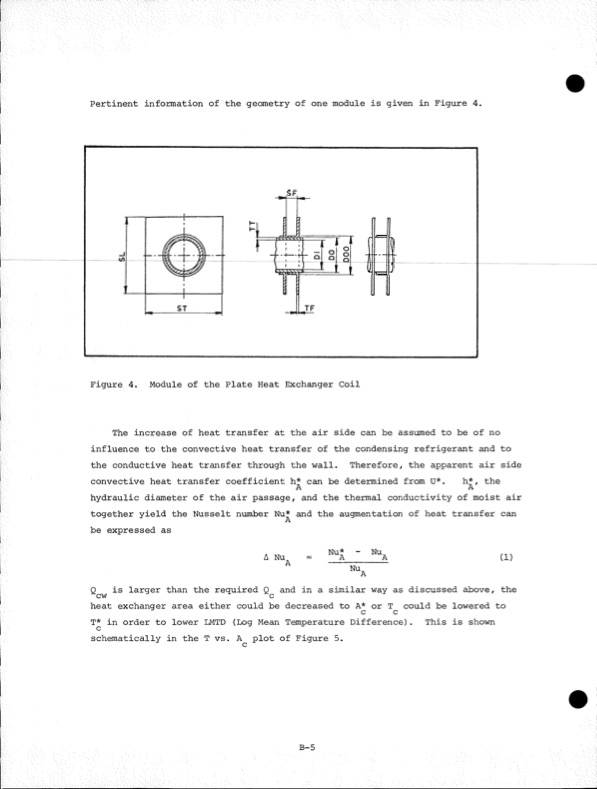
Pertinent information of the geometry of one module is given in Figure 4. Figure 4. Module of the Plate Heat Exchanger Coil The increase of heat transfer at the air side can be assumed to be of no influence to the convective heat transfer of the condensing refrigerant and to the conductive heat transfer through the wall. Therefore, the apparent air side convective heat transfer coefficient h* can be determined from u*. h*, the AA hydraulic diameter of the air passage, and the thermal conductivity of moist air together yield the Nusselt number Nu* and the augmentation of heat transfer can be expressed as Q is larger than the required Q and in a similar way as discussed above, the cw c Nu* A NuA A Nu A (1) heat exchanger area either could be decreased to A* or T could be lowered to cc T* in order to lower LMTD (Log Mean Temperature Difference). c schematically in the T vs. A plot of Figure 5. c This is shown B-5 Nu APDF Image | Development of the Zinc-Chlorine Battery for Utility
PDF Search Title:
Development of the Zinc-Chlorine Battery for UtilityOriginal File Name Searched:
6302789.pdfDIY PDF Search: Google It | Yahoo | Bing
Salgenx Redox Flow Battery Technology: Power up your energy storage game with Salgenx Salt Water Battery. With its advanced technology, the flow battery provides reliable, scalable, and sustainable energy storage for utility-scale projects. Upgrade to a Salgenx flow battery today and take control of your energy future.
| CONTACT TEL: 608-238-6001 Email: greg@salgenx.com | RSS | AMP |