PDF Publication Title:
Text from PDF Page: 249
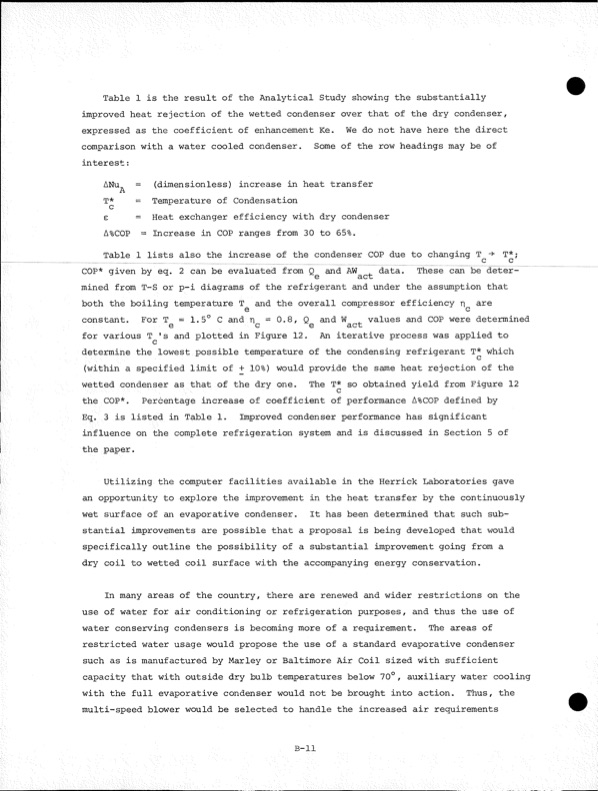
Table 1 is the result of the Analytical Study showing the substantially improved heat rejection of the wetted condenser over that of the dry condenser, expressed as the coefficient of enhancement Ke. We do not have here the direct comparison with a water cooled condenser. Some of the row headings may be of interest: ANu^ = (dimensionless) increase in heat transfer T* = Temperature of Condensation e = Heat exchanger efficiency with dry condenser A%COP = Increase in COP ranges from 30 to 65%. Table 1 lists also the increase of the condenser COP due to changing T -+ T*; ......................._..... .......... _ cc _ COP* given by eq. 2 can be evaluated from Q and AW data. These can be deter- g act mined from T-S or p-i diagrams of the refrigerant and under the assumption that both the boiling temperature T^ and the overall compressor efficiency ric are constant. For T = 1.5° C and n = 0.8, Q and W ^ values and COP were determined e c e act for various T 1s and plotted in Figure 12. An iterative process was applied to c determine the lowest possible temperature of the condensing refrigerant T* which (within a specified limit of + 10%) would provide the same heat rejection of the wetted condenser as that of the dry one. The T* so obtained yield from Figure 12 the COP*. Percentage increase of coefficient of performance A%COP defined by Eq. 3 is listed in Table 1. Improved condenser performance has significant influence on the complete refrigeration system and is discussed in Section 5 of the paper. Utilizing the computer facilities available in the Herrick Laboratories gave an opportunity to explore the improvement in the heat transfer by the continuously wet surface of an evaporative condenser. It has been determined that such sub stantial improvements are possible that a proposal is being developed that would specifically outline the possibility of a substantial improvement going from a dry coil to wetted coil surface with the accompanying energy conservation. In many areas of the country, there are renewed and wider restrictions on the use of water for air conditioning or refrigeration purposes, and thus the use of water conserving condensers is becoming more of a requirement. The areas of restricted water usage would propose the use of a standard evaporative condenser such as is manufactured by Marley or Baltimore Air Coil sized with sufficient capacity that with outside dry bulb temperatures below 70°, auxiliary water cooling with the full evaporative condenser would not be brought into action. Thus, the multi-speed blower would be selected to handle the increased air requirements B—11PDF Image | Development of the Zinc-Chlorine Battery for Utility
PDF Search Title:
Development of the Zinc-Chlorine Battery for UtilityOriginal File Name Searched:
6302789.pdfDIY PDF Search: Google It | Yahoo | Bing
Salgenx Redox Flow Battery Technology: Power up your energy storage game with Salgenx Salt Water Battery. With its advanced technology, the flow battery provides reliable, scalable, and sustainable energy storage for utility-scale projects. Upgrade to a Salgenx flow battery today and take control of your energy future.
| CONTACT TEL: 608-238-6001 Email: greg@salgenx.com | RSS | AMP |