PDF Publication Title:
Text from PDF Page: 258
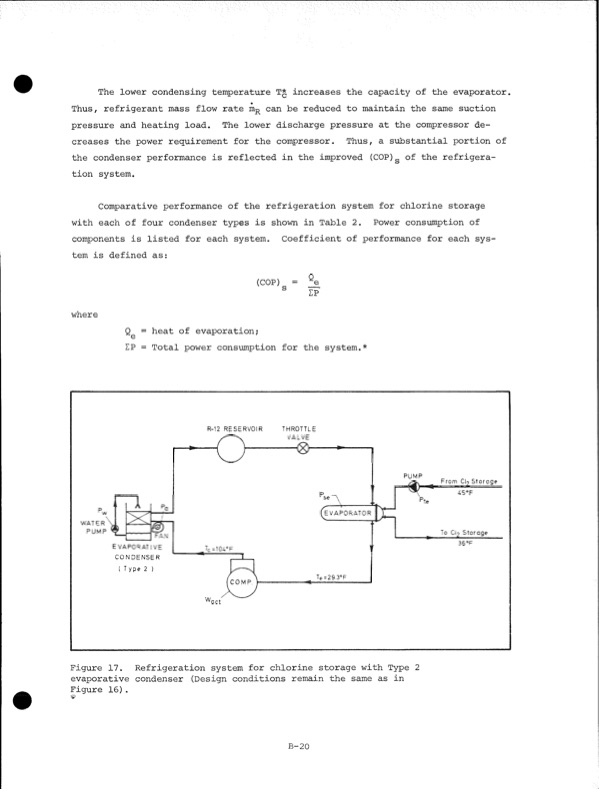
The lower condensing temperature Tg increases the capacity of the evaporator. Thus, refrigerant mass flow rate mR can be reduced to maintain the same suction pressure and heating load. The lower discharge pressure at the compressor de creases the power requirement for the compressor. Thus, a substantial portion of the condenser performance is reflected in the improved (COP)s of the refrigera tion system. Comparative performance of the refrigeration system for chlorine storage with each of four condenser types is shown in Table 2. Power consumption of components is listed for each system. Coefficient of performance for each sys tem is defined as: where (COP) s Qe = heat of evaporation; EP = Total power consumption for the system.* R-12 RESERVOIR \ THROTTLE VALVE PUMP From OH Storage EVAPORATIVE CONDENSER I T ype 2 ) Figure 17. Refrigeration system for chlorine storage with Type 2 evaporative condenser (Design conditions remain the same as in Figure 16). B-20PDF Image | Development of the Zinc-Chlorine Battery for Utility
PDF Search Title:
Development of the Zinc-Chlorine Battery for UtilityOriginal File Name Searched:
6302789.pdfDIY PDF Search: Google It | Yahoo | Bing
Salgenx Redox Flow Battery Technology: Power up your energy storage game with Salgenx Salt Water Battery. With its advanced technology, the flow battery provides reliable, scalable, and sustainable energy storage for utility-scale projects. Upgrade to a Salgenx flow battery today and take control of your energy future.
| CONTACT TEL: 608-238-6001 Email: greg@salgenx.com | RSS | AMP |