PDF Publication Title:
Text from PDF Page: 260
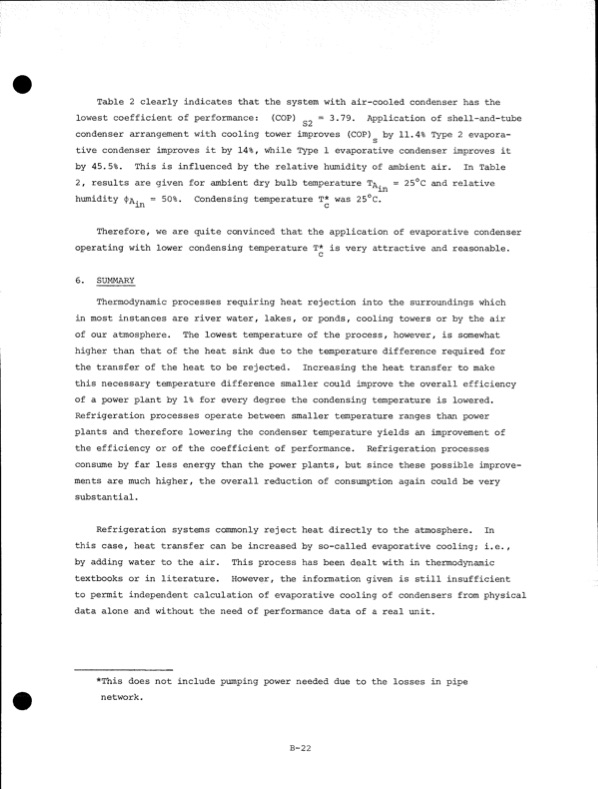
Table 2 clearly indicates that the system with air-cooled condenser has the lowest coefficient of performance: (COP) = 3.79. Application of shell-and-tube condenser arrangement with cooling tower improves (COP) by 11.4% Type 2 evapora tive condenser improves it by 14%, while Type 1 evaporative condenser improves it by 45.5%. This is influenced by the relative humidity of ambient air. In Table 2, results are given for ambient dry bulb temperature To,. = 25°C and relative m humidity ‘t’A^ = 50%. Condensing temperature T* was 25°C. Therefore, we are quite convinced that the application of evaporative condenser operating with lower condensing temperature T* is very attractive and reasonable. c 6. SUMMARY Thermodynamic processes requiring heat rejection into the surroundings which in most instances are river water, lakes, or ponds, cooling towers or by the air of our atmosphere. The lowest temperature of the process, however, is somewhat higher than that of the heat sink due to the temperature difference required for the transfer of the heat to be rejected. Increasing the heat transfer to make this necessary temperature difference smaller could improve the overall efficiency of a power plant by 1% for every degree the condensing temperature is lowered. Refrigeration processes operate between smaller temperature ranges than power plants and therefore lowering the condenser temperature yields an improvement of the efficiency or of the coefficient of performance. Refrigeration processes consume by far less energy than the power plants, but since these possible improve ments are much higher, the overall reduction of consumption again could be very substantial. Refrigeration systems commonly reject heat directly to the atmosphere. In this case, heat transfer can be increased by so-called evaporative cooling; i.e., by adding water to the air. This process has been dealt with in thermodynamic textbooks or in literature. However, the information given is still insufficient to permit independent calculation of evaporative cooling of condensers from physical data alone and without the need of performance data of a real unit. *This does not include pumping power needed due to the losses in pipe network. B-22PDF Image | Development of the Zinc-Chlorine Battery for Utility
PDF Search Title:
Development of the Zinc-Chlorine Battery for UtilityOriginal File Name Searched:
6302789.pdfDIY PDF Search: Google It | Yahoo | Bing
Salgenx Redox Flow Battery Technology: Power up your energy storage game with Salgenx Salt Water Battery. With its advanced technology, the flow battery provides reliable, scalable, and sustainable energy storage for utility-scale projects. Upgrade to a Salgenx flow battery today and take control of your energy future.
| CONTACT TEL: 608-238-6001 Email: greg@salgenx.com | RSS | AMP |