
PDF Publication Title:
Text from PDF Page: 276
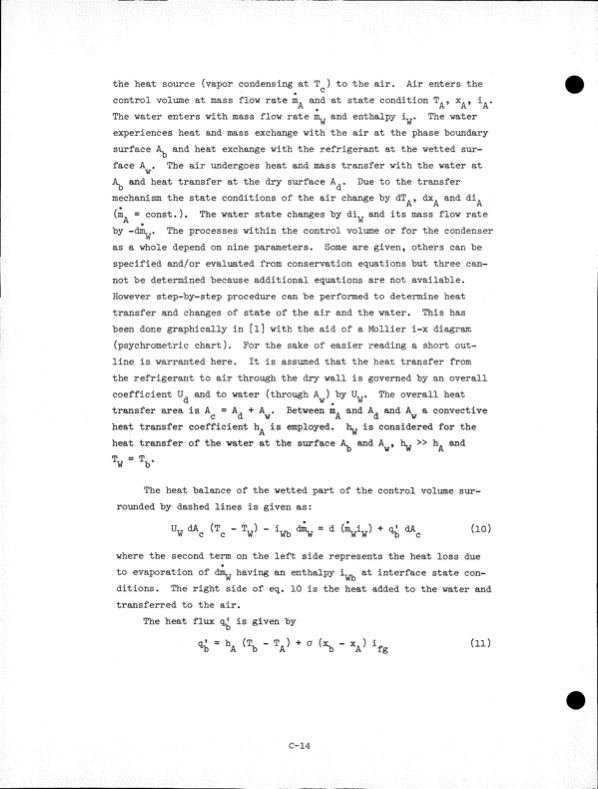
the heat source (vapor condensing at T ) to the air. Air enters the a control volume at mass flow rate and at state condition T^, x^, i^. a The water enters with mass flow rate and enthalpy i^. The water experiences heat and mass exchange with the air at the phase houndary surface and heat exchange with the refrigerant at the wetted sur faceA^. Theairundergoesheatandmasstransferwiththewaterat A^andheattransferatthedrysurfaceA^. Duetothetransfer mechanism the state conditions of the air change hy dT^, dx^ and di^ (m = const.). The water state changes hy di and its mass flow rate AW hy-dm^. Theprocesseswithinthecontrolvolumeorforthecondenser asawholedependonnineparameters. Somearegiven,otherscanhe specified and/or evaluated from conservation equations hut three can not he determined because additional equations are not available. However step-hy-step procedure can he performed to determine heat transferandchangesofstateoftheairandthewater. Thishas been done graphically in [l] with the aid of a Mollier i-x diagram (psychrometric chart). For the sake of easier reading a short out lineiswarrantedhere. Itisassumedthattheheattransferfrom the refrigerant to air through the dry wall is governed hy an overall coefficient U, and to water (through A ) hy UTT. The overall heat transfer area is A A, + A . Between m, and A, and A a convective dwAdw heat transfer coefficient h^ is employed, h^ is considered for the d. w^ W heat transfer of the water at the surface and A T„ = T. . ¥h ^ >> hA and The heat balance of the wetted part of the control volume sur- rounded hy dashed lines is given as: UW ^c (Tc - V " ^ ^ = d (Vw) + K (10) where the second term on the left side represents the heat loss due 0 to evaporation of dm^ having an enthalpy i at interface state con ditions. The right side of eq. 10 is the heat added to the water and transferred to the air. The heat flux q^ is given hy ^h = hA (Tb ” TA) + 0 K - XA) 1fg (11) C-14PDF Image | Development of the Zinc-Chlorine Battery for Utility
PDF Search Title:
Development of the Zinc-Chlorine Battery for UtilityOriginal File Name Searched:
6302789.pdfDIY PDF Search: Google It | Yahoo | Bing
Salgenx Redox Flow Battery Technology: Power up your energy storage game with Salgenx Salt Water Battery. With its advanced technology, the flow battery provides reliable, scalable, and sustainable energy storage for utility-scale projects. Upgrade to a Salgenx flow battery today and take control of your energy future.
| CONTACT TEL: 608-238-6001 Email: greg@salgenx.com | RSS | AMP |