PDF Publication Title:
Text from PDF Page: 311
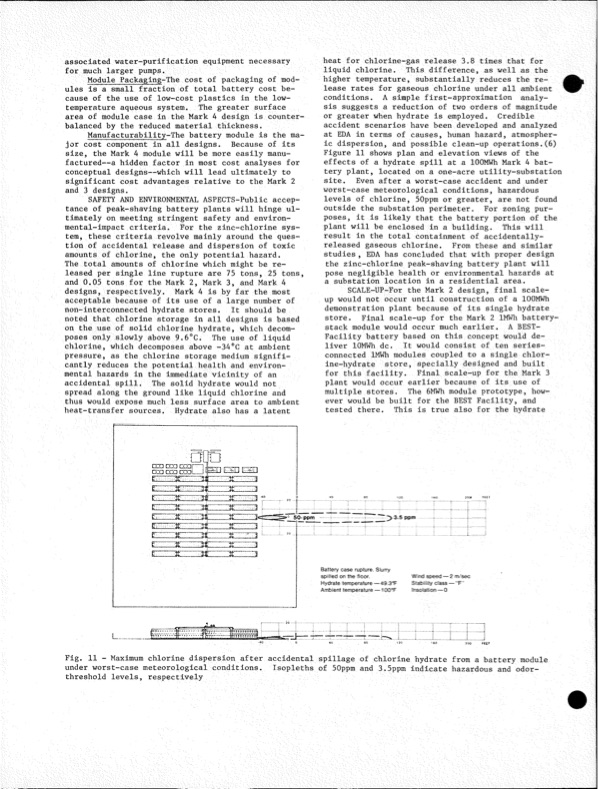
associated water-purification equipment necessary for much larger pumps. Module PackagIng-The cost of packaging of mod ules is a small fraction of total battery cost be cause of the use of low-cost plastics in the low- temperatureaqueoussystem. Thegreatersurface area of module case in the Mark 4 design is counter balanced by the reduced material thickness. Manufacturability-The battery module is the ma jor cost component in all designs. Because of its size, the Mark 4 module will be more easily manu factured— a hidden factor in most cost analyses for conceptual designs—which will lead ultimately to significantcostadvantagesrelativetotheMark2 and 3 designs. SAFETY AND ENVIRONMENTAL ASPECTS-Public accep tance of peak-shaving battery plants will hinge ul timately on meeting stringent safety and environ mental-impact criteria. For the zinc-chlorine sys tem, these criteria revolve mainly around the ques tion of accidental release and dispersion of toxic amounts of chlorine, the only potential hazard. The total amounts of chlorine which might be re leased per single line rupture are 75 tons, 25 tons, and 0.05 tons for the Mark 2, Mark 3, and Mark 4 designs, respectively. Mark 4 is by far the most acceptable because of its use of a large number of non-interconnectedhydratestores. Itshouldbe noted that chlorine storage in all designs is based on the use of solid chlorine hydrate, which decom poses only slowly above 9.6°C. The use of liquid chlorine,whichdecomposesabove-34°Catambient pressure, as the chlorine storage medium signifi cantly reduces the potential health and environ mental hazards in the immediate vicinity of an accidentalspill. Thesolidhydratewouldnot spread along the ground like liquid chlorine and thus would expose much less surface area to ambient heat-transfer sources. Hydrate also has a latent heat for chlorine-gas release 3.8 times that for liquid chlorine. This difference, as well as the higher temperature, substantially reduces the re lease rates for gaseous chlorine under all ambient conditions. A simple first-approximation analy sissuggestsareductionoftwoordersofmagnitude or greater when hydrate is employed. Credible accident scenarios have been developed and analyzed at EDA in terms of causes, human hazard, atmospher ic dispersion, and possible clean-up operations.(6) Figure 11 shows plan and elevation views of the effects of a hydrate spill at a lOOMWh Mark 4 bat tery plant, located on a one-acre utility-substation site. Evenafteraworst-caseaccidentandunder worst-case meteorological conditions, hazardous levels of chlorine, 50ppm or greater, are not found outside the substation perimeter. For zoning pur poses, it is likely that the battery portion of the plant will be enclosed in a building. This will result in the total containment of accidentally- released gaseous chlorine. From these and similar studies , EDA has concluded that with proper design the zinc-chlorine peak-shaving battery plant will pose negligible health or environmental hazards at a substation location in a residential area. SCALE-UP-For the Mark 2 design, final scale- up would not occur until construction of a lOOMWh demonstration plant because of its single hydrate store. Finalscale-upfortheMark2IMWhbattery- stack module would occur much earlier. A BEST- Facility battery based on this concept would de liverlOMWhdc. Itwouldconsistoftenseries- connected IMWh modules coupled to a single chlor ine-hydrate store, specially designed and built for this facility. Final scale-up for the Mark 3 plantwouldoccurearlierbecauseofitsuseof multiple stores. The 6MWh module prototype, how ever would be built for the BEST Facility, and tested there. This is true also for the hydrate 3.5ppm r~nrmrmf an rm rm rm rm rml 50*ppm Battery case rupture. Slurry spilled on the floor. Hydrate temperature — 49.3°F Ambient temperature — 100°F Wind speed — 2 m/sec Stability class — “F'' Insolation —0 Fig. 11 - Maximum chlorine dispersion after accidental spillage of chlorine hydrate from a battery module underworst-casemeteorologicalconditions. Isoplethsof50ppmand3.5ppmindicatehazardousandodor- threshold levels, respectivelyPDF Image | Development of the Zinc-Chlorine Battery for Utility
PDF Search Title:
Development of the Zinc-Chlorine Battery for UtilityOriginal File Name Searched:
6302789.pdfDIY PDF Search: Google It | Yahoo | Bing
Salgenx Redox Flow Battery Technology: Power up your energy storage game with Salgenx Salt Water Battery. With its advanced technology, the flow battery provides reliable, scalable, and sustainable energy storage for utility-scale projects. Upgrade to a Salgenx flow battery today and take control of your energy future.
CONTACT TEL: 608-238-6001 Email: greg@salgenx.com (Standard Web Page)