PDF Publication Title:
Text from PDF Page: 004
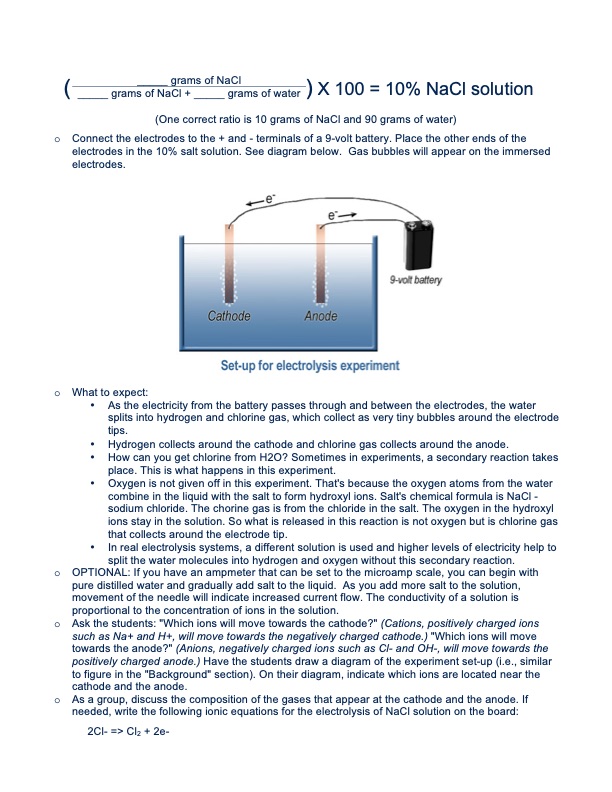
( _____ grams of NaCl ) X 100 = 10% NaCl solution _____ grams of NaCl + _____ grams of water (One correct ratio is 10 grams of NaCl and 90 grams of water) Connecttheelectrodestothe+and-terminalsofa9-voltbattery.Placetheotherendsofthe electrodes in the 10% salt solution. See diagram below. Gas bubbles will appear on the immersed electrodes. Whattoexpect: • As the electricity from the battery passes through and between the electrodes, the water splits into hydrogen and chlorine gas, which collect as very tiny bubbles around the electrode tips. • Hydrogen collects around the cathode and chlorine gas collects around the anode. • How can you get chlorine from H2O? Sometimes in experiments, a secondary reaction takes place. This is what happens in this experiment. • Oxygen is not given off in this experiment. That's because the oxygen atoms from the water combine in the liquid with the salt to form hydroxyl ions. Salt's chemical formula is NaCl - sodium chloride. The chorine gas is from the chloride in the salt. The oxygen in the hydroxyl ions stay in the solution. So what is released in this reaction is not oxygen but is chlorine gas that collects around the electrode tip. • In real electrolysis systems, a different solution is used and higher levels of electricity help to split the water molecules into hydrogen and oxygen without this secondary reaction. OPTIONAL:Ifyouhaveanampmeterthatcanbesettothemicroampscale,youcanbeginwith pure distilled water and gradually add salt to the liquid. As you add more salt to the solution, movement of the needle will indicate increased current flow. The conductivity of a solution is proportional to the concentration of ions in the solution. Askthestudents:"Whichionswillmovetowardsthecathode?"(Cations,positivelychargedions such as Na+ and H+, will move towards the negatively charged cathode.) "Which ions will move towards the anode?" (Anions, negatively charged ions such as Cl- and OH-, will move towards the positively charged anode.) Have the students draw a diagram of the experiment set-up (i.e., similar to figure in the "Background" section). On their diagram, indicate which ions are located near the cathode and the anode. Asagroup,discussthecompositionofthegasesthatappearatthecathodeandtheanode.If needed, write the following ionic equations for the electrolysis of NaCl solution on the board: o o o o o 2Cl- => Cl2 + 2e-PDF Image | ELECTROLYSIS OF SALT WATER
PDF Search Title:
ELECTROLYSIS OF SALT WATEROriginal File Name Searched:
electrolysis.pdfDIY PDF Search: Google It | Yahoo | Bing
Salgenx Redox Flow Battery Technology: Power up your energy storage game with Salgenx Salt Water Battery. With its advanced technology, the flow battery provides reliable, scalable, and sustainable energy storage for utility-scale projects. Upgrade to a Salgenx flow battery today and take control of your energy future.
CONTACT TEL: 608-238-6001 Email: greg@salgenx.com (Standard Web Page)