PDF Publication Title:
Text from PDF Page: 004
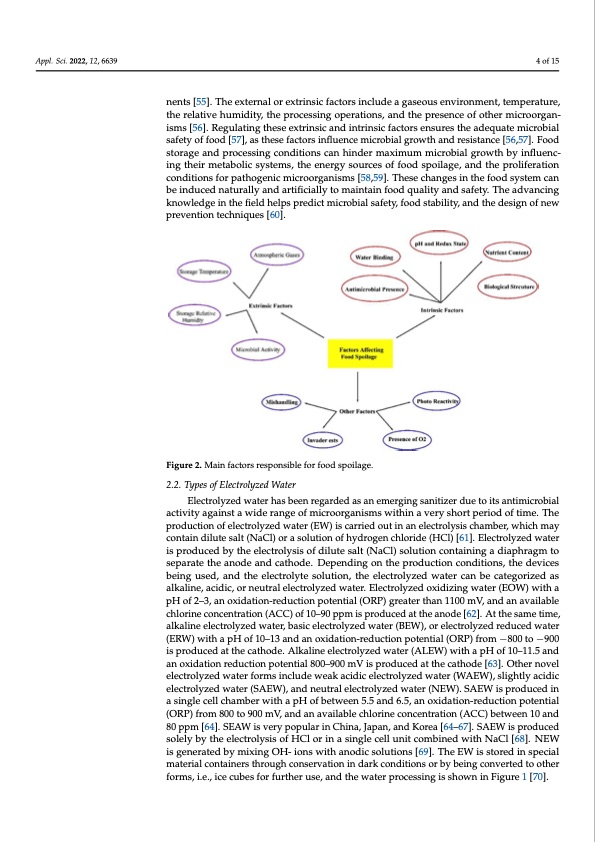
Appl. Sci. 2022, 12, 6639 2.1. Main Factors Responsible for Food Spoilage To enhance food safety and product quality, intrinsic and extrinsic factors are 4botfh15 naturally and artificially modulated. The adjustments made to these factors/conditions minimize and/or prevent the growth and establishment of microbial flora, which in turn escalates the shelf-life of food [54]. Figure 2 summarizes the factors responsible for food Appl. Sci. 2022, 12, x FOR PEER REVIEW 4 of 15 spoilage. The inherent or intrinsic factors include the chemical, physical, and biological nents [55]. The external or extrinsic factors include a gaseous environment, temperature, makeup of the food matrix, i.e., water activity, pH, moisture content, food composition, the relative humidity, the processing operations, and the presence of other microorgan- redox potential (oxidation-reduction), biological structures, and antimicrobial compo- isms [56]. Regulating these extrinsic and intrinsic factors ensures the adequate microbial nents [55]. The external or extrinsic factors include a gaseous environment, temperature, safety of food [57], as these factors influence microbial growth and resistance [56,57]. Food the relative humidity, the processing operations, and the presence of other microorgan- isms [56]. Regulating these extrinsic and intrinsic factors ensures the adequate microbial storage and processing conditions can hinder maximum microbial growth by influenc- safety of food [57], as these factors influence microbial growth and resistance [56,57]. Food ing their metabolic systems, the energy sources of food spoilage, and the proliferation storage and processing conditions can hinder maximum microbial growth by influencing conditionsforpathothgeeirnmicetmaboiclircosoysrtgemans,itshmeesne[r5g8y,5so9u]r.cTeshoefsfoeodchspaonilgagees,aindththepforolidfersaytisotnecmondcia-n tions for pathogenic microorganisms [58,59]. These changes in the food system can be in- be induced naturally and artificially to maintain food quality and safety. The advancing duced naturally and artificially to maintain food quality and safety. The advancing knowledge in the field helps predict microbial safety, food stability, and the design of new knowledge in the field helps predict microbial safety, food stability, and the design of new prevention techniques [60]. prevention techniques [60]. Figure 2. Main factors responsible for food spoilage. Figure 2. Main factors responsible for food spoilage. 2.2. Types of Electrolyzed Water 2.2. Types of Electrolyzed Water Electrolyzed water has been regarded as an emerging sanitizer due to its antimicro- Electrolyzedwabtiaelrahctaivsitbyeaegnainrsetgaawrdidedraansgeanofemmicreorogrignangismasnwititzheinradvueerytoshiotrstpaenrtioimdoicfrtiombei.al The production of electrolyzed water (EW) is carried out in an electrolysis chamber, which activity against a wide range of microorganisms within a very short period of time. The may contain dilute salt (NaCl) or a solution of hydrogen chloride (HCl) [61]. Electrolyzed production of electrolyzed water (EW) is carried out in an electrolysis chamber, which may water is produced by the electrolysis of dilute salt (NaCl) solution containing a diaphragm containdilutesalt(NtoasCepl)aroarteathseoalnuotdioenanodfcahthyodreo.gDepnencdhilnogroidneth(eHprCodl)u[c6ti1on].cEonledcittioronsl,ytzhedewvicaetser being used, and the electrolyte solution, the electrolyzed water can be categorized as al- is produced by the electrolysis of dilute salt (NaCl) solution containing a diaphragm to kaline, acidic, or neutral electrolyzed water. Electrolyzed oxidizing water (EOW) with a separate the anode and cathode. Depending on the production conditions, the devices being used, and the electrolyte solution, the electrolyzed water can be categorized as alkaline, acidic, or neutral electrolyzed water. Electrolyzed oxidizing water (EOW) with a pH of 2–3, an oxidation-reduction potential (ORP) greater than 1100 mV, and an available chlorine concentration (ACC) of 10–90 ppm is produced at the anode [62]. At the same time, alkaline electrolyzed water, basic electrolyzed water (BEW), or electrolyzed reduced water (ERW) with a pH of 10–13 and an oxidation-reduction potential (ORP) from −800 to −900 is produced at the cathode. Alkaline electrolyzed water (ALEW) with a pH of 10–11.5 and an oxidation reduction potential 800–900 mV is produced at the cathode [63]. Other novel electrolyzed water forms include weak acidic electrolyzed water (WAEW), slightly acidic electrolyzed water (SAEW), and neutral electrolyzed water (NEW). SAEW is produced in a single cell chamber with a pH of between 5.5 and 6.5, an oxidation-reduction potential (ORP) from 800 to 900 mV, and an available chlorine concentration (ACC) between 10 and 80 ppm [64]. SEAW is very popular in China, Japan, and Korea [64–67]. SAEW is produced solely by the electrolysis of HCl or in a single cell unit combined with NaCl [68]. NEW is generated by mixing OH- ions with anodic solutions [69]. The EW is stored in special material containers through conservation in dark conditions or by being converted to other forms, i.e., ice cubes for further use, and the water processing is shown in Figure 1 [70].PDF Image | Electrolyzed Water in the Food Industry
PDF Search Title:
Electrolyzed Water in the Food IndustryOriginal File Name Searched:
applsci-12-06639-v2.pdfDIY PDF Search: Google It | Yahoo | Bing
Salgenx Redox Flow Battery Technology: Power up your energy storage game with Salgenx Salt Water Battery. With its advanced technology, the flow battery provides reliable, scalable, and sustainable energy storage for utility-scale projects. Upgrade to a Salgenx flow battery today and take control of your energy future.
| CONTACT TEL: 608-238-6001 Email: greg@salgenx.com | RSS | AMP |