
PDF Publication Title:
Text from PDF Page: 010
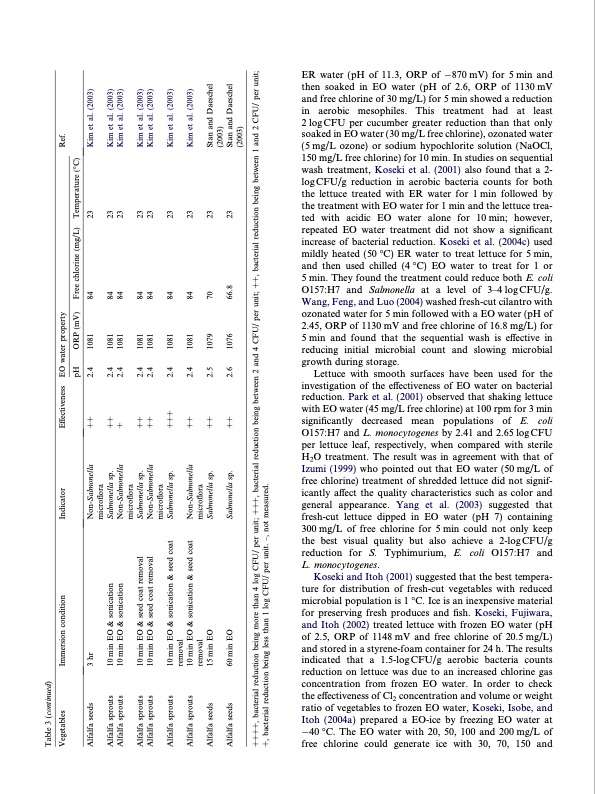
ER water (pH of 11.3, ORP of 870 mV) for 5 min and then soaked in EO water (pH of 2.6, ORP of 1130 mV and free chlorine of 30 mg/L) for 5 min showed a reduction in aerobic mesophiles. This treatment had at least 2 log CFU per cucumber greater reduction than that only soaked in EO water (30 mg/L free chlorine), ozonated water (5 mg/L ozone) or sodium hypochlorite solution (NaOCl, 150 mg/L free chlorine) for 10 min. In studies on sequential wash treatment, Koseki et al. (2001) also found that a 2- logCFU/g reduction in aerobic bacteria counts for both the lettuce treated with ER water for 1 min followed by the treatment with EO water for 1 min and the lettuce trea- ted with acidic EO water alone for 10min; however, repeated EO water treatment did not show a significant increase of bacterial reduction. Koseki et al. (2004c) used mildly heated (50 °C) ER water to treat lettuce for 5 min, and then used chilled (4 °C) EO water to treat for 1 or 5 min. They found the treatment could reduce both E. coli O157:H7 and Salmonella at a level of 3–4 log CFU/g. Wang, Feng, and Luo (2004) washed fresh-cut cilantro with ozonated water for 5 min followed with a EO water (pH of 2.45, ORP of 1130 mV and free chlorine of 16.8 mg/L) for 5 min and found that the sequential wash is effective in reducing initial microbial count and slowing microbial growth during storage. Lettuce with smooth surfaces have been used for the investigation of the effectiveness of EO water on bacterial reduction. Park et al. (2001) observed that shaking lettuce with EO water (45 mg/L free chlorine) at 100 rpm for 3 min significantly decreased mean populations of E. coli O157:H7 and L. monocytogenes by 2.41 and 2.65 log CFU per lettuce leaf, respectively, when compared with sterile H2O treatment. The result was in agreement with that of Izumi (1999) who pointed out that EO water (50 mg/L of free chlorine) treatment of shredded lettuce did not signif- icantly affect the quality characteristics such as color and general appearance. Yang et al. (2003) suggested that fresh-cut lettuce dipped in EO water (pH 7) containing 300 mg/L of free chlorine for 5 min could not only keep the best visual quality but also achieve a 2-logCFU/g reduction for S. Typhimurium, E. coli O157:H7 and L. monocytogenes. Koseki and Itoh (2001) suggested that the best tempera- ture for distribution of fresh-cut vegetables with reduced microbial population is 1 °C. Ice is an inexpensive material for preserving fresh produces and fish. Koseki, Fujiwara, and Itoh (2002) treated lettuce with frozen EO water (pH of 2.5, ORP of 1148 mV and free chlorine of 20.5 mg/L) and stored in a styrene-foam container for 24 h. The results indicated that a 1.5-logCFU/g aerobic bacteria counts reduction on lettuce was due to an increased chlorine gas concentration from frozen EO water. In order to check the effectiveness of Cl2 concentration and volume or weight ratio of vegetables to frozen EO water, Koseki, Isobe, and Itoh (2004a) prepared a EO-ice by freezing EO water at 40 °C. The EO water with 20, 50, 100 and 200 mg/L of free chlorine could generate ice with 30, 70, 150 and Table 3 (continued) Vegetables water property (mV) Ref. Free chlorine (mg/L) Temperature (°C) Alfalfa seeds 3hr Non-Salmonella microflora Salmonella sp. Non-Salmonella microflora Salmonella sp. Non-Salmonella microflora Salmonella sp. ++ 2.4 1081 84 23 Kim et al. (2003) Alfalfa sprouts Alfalfa sprouts 10 min EO 10 min EO & sonication & sonication ++ 2.4 + 2.4 1081 1081 84 23 84 23 Kim et al. (2003) Kim et al. (2003) Alfalfa sprouts Alfalfa sprouts 10 min EO 10 min EO & seed coat removal & seed coat removal ++ 2.4 ++ 2.4 1081 1081 84 23 84 23 Kim et al. (2003) Kim et al. (2003) Alfalfa sprouts Alfalfa sprouts Alfalfa seeds Alfalfa seeds 10 min EO removal 10 min EO removal 15 min EO & sonication & seed coat & sonication & seed coat +++ 2.4 ++ 2.4 ++ 2.5 ++ 2.6 1081 1081 1079 1076 84 23 84 23 70 23 66.8 23 Kim et al. (2003) Immersion condition Indicator Effectiveness EO pH ORP 60 min EO Salmonella sp. Stan and Daeschel (2003) Stan and Daeschel (2003) Non-Salmonella microflora Salmonella sp. Kim et al. (2003) ++++, bacterial reduction being more than 4 log CFU/ per unit; +++, bacterial reduction being between 2 and 4 CFU/ per unit; ++, bacterial reduction being between 1 and 2 CFU/ per unit; +, bacterial reduction being less than 1 log CFU/ per unit. –, not measured.PDF Image | electrolyzed water in the food industry ROC
PDF Search Title:
electrolyzed water in the food industry ROCOriginal File Name Searched:
Applications-of-eWater-Huang-et-al.pdfDIY PDF Search: Google It | Yahoo | Bing
Salgenx Redox Flow Battery Technology: Power up your energy storage game with Salgenx Salt Water Battery. With its advanced technology, the flow battery provides reliable, scalable, and sustainable energy storage for utility-scale projects. Upgrade to a Salgenx flow battery today and take control of your energy future.
| CONTACT TEL: 608-238-6001 Email: greg@salgenx.com | RSS | AMP |