PDF Publication Title:
Text from PDF Page: 026
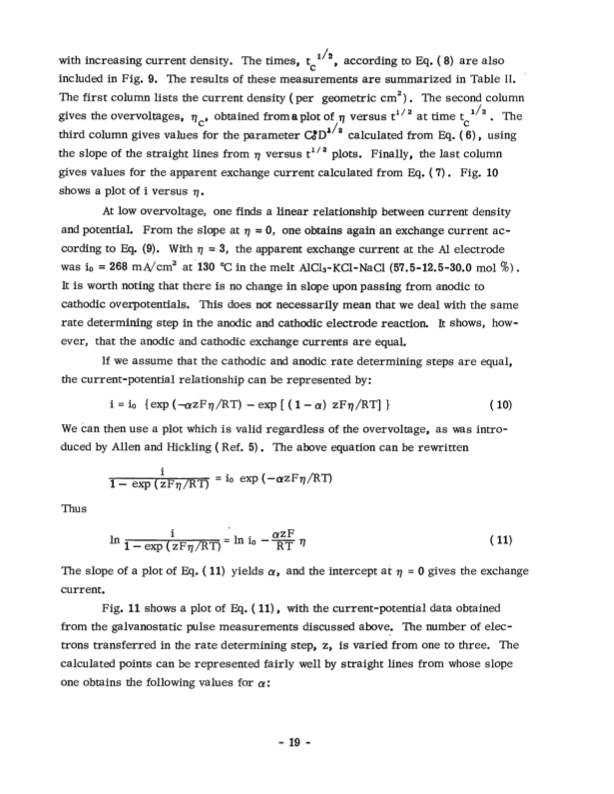
with increasing current density. The times, tC 1’2s according to Eq. ( 8) a r e also included in Fig. 9, The results of these measurements are summarized in Table 11. The first column lists the current density (per geometric cm’) . The second column gives the overvoltages, qC obtained fromaplot of q versus tl” at time tC1’2. The third column gives values for the parameter C0.DL/2calculated from Eq. (6) using the slope of the straight lines from q versus t1’2 plots. Finally, the last column gives values for the apparent exchange current calculated from Eq. (7). Fig. 10 shows a plot of i versus q. At low overvoltage, one finds a linear relationship between current density and potential. From the slope at q = 0, one obtains again an exchange current ac- cording to Eq. (9). With q = 3, the apparent exchange current at the Al electrode was io = 268 mA/cm2 at 130 “Cin the melt AlC13-KCl-NaCl (57.5-12.5-30.0 mol %). It is worth noting that there is no change in slope upon passing from anodic to cathodic overpotentials. This does not necessarily mean that we deal with the same rate determining step in the anodic and cathodic electrode reaction. It shows, how- ever, that the anodic and cathodic exchange currents are equal. If we assume that the cathodic and anodic rate determining steps are equal, the current-potential relationship can be represented by: i=io {exp(-zFq/RT) -exp[(1-a)zFq/RT] } (10) We can then use a plot which is valid regardless of the overvoltage, as was intro- = In io-- The slope of a plot of Eq. ( 11) yields a,and the intercept at q = 0 gives the exchange current.Fig. 11showsaplotofEq.(11),withthecurrent-potentialdataobtained from the galvanostatic pulse measurements discussed above. The number of elec- trons transferred in the rate determining step, z, is varied from one to three. The calculated points can be represented fairly well by straight lines from whose slope one obtains the following values for a: duced by Allen and Hickling ( Ref. 5). The above equation can be rewritten i 1-exp(zFq/RT) = io exp(-~ZP;~/RT) Thus In 1-exp ( Z F ~ / R T ) R T i azFPDF Image | NASA ALUMINUM CHLORINE BATTERY
PDF Search Title:
NASA ALUMINUM CHLORINE BATTERYOriginal File Name Searched:
19700023353.pdfDIY PDF Search: Google It | Yahoo | Bing
Salgenx Redox Flow Battery Technology: Power up your energy storage game with Salgenx Salt Water Battery. With its advanced technology, the flow battery provides reliable, scalable, and sustainable energy storage for utility-scale projects. Upgrade to a Salgenx flow battery today and take control of your energy future.
CONTACT TEL: 608-238-6001 Email: greg@salgenx.com (Standard Web Page)