PDF Publication Title:
Text from PDF Page: 030
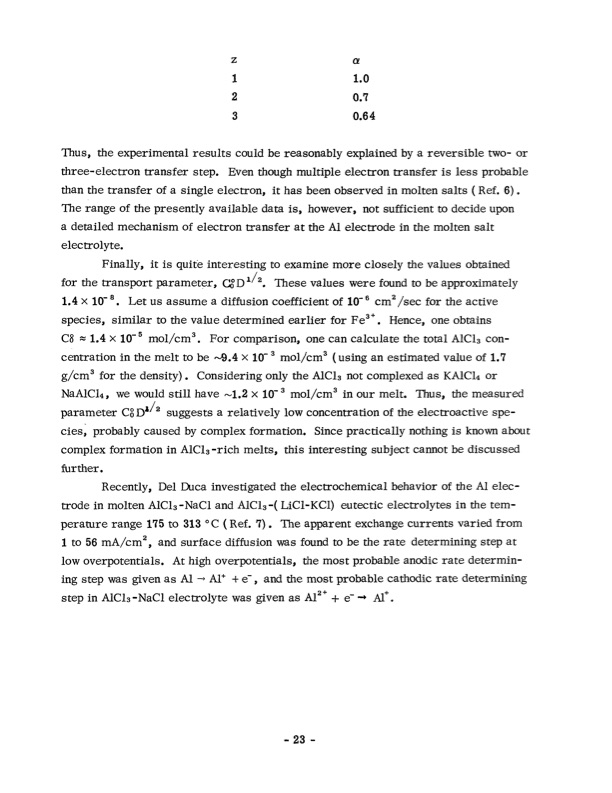
a! 1.0 0.7 0.6 4 Thus, the experimental results could be reasonably explained by a reversible two- or three-electron transfer step. Even though multiple electron transfer is less probable than the transfer of a single electron, it has been observed in molten salts (Ref. 6). The range of the presently available data is, however, not sufficient to decide upon a detailed mechanism of electron transfer at the A1 electrode in the molten salt electrolyte. Finally, it is quite interesting to examine more closely the values obtained for the transport parameter, GD'/'. These values were found to be approximately 1.4 X 10- 8 . Let us assume a diffusion coefficient of loe6 cm2/sec for the active species, similar to the value determined earlier for Fe3', Hence, one obtains C8 = 1.4 X mol/cm3. For comparison, one can calculate the total A1C13 con- centration in the melt to be -9.4 x 10- mol/cm3 (using an estimated value of 1.7 g/cm3 for the density). Considering only the not complexed as KAlCb or NaA1C14, we would still have -1.2 x lom3mol/em3 in our melt. Thus, the measured parameter C; ~ 4 su2ggests a relatively low concentration of the electroactive spe- cies, probably caused by complex formation. Since practically nothing is known about complex formation in A1Cl3-rich melts, this interesting subject cannot be discussed further. Recently, Del Duca investigated the electrochemical behavior of the A1 elec- trode in molten A1Cl3-NaC1 and AIC13-( LiC1-KC1) eutectic electrolytes in the tem- perature range 175to 313"C(Ref. 7)e The apparent exchange currents varied from 1to 56 mA/cm2, and surface diffusion was found to be the rate determining step at low overpotentials. At high overpotentials, the most probable anodic rate determin- ing step was given as A1 -+ Al+ -k e- and the most probable cathodic rate determining step in AIC13-NaCl electrolyte was given as A12++ e' 4 Al'. -23-PDF Image | NASA ALUMINUM CHLORINE BATTERY
PDF Search Title:
NASA ALUMINUM CHLORINE BATTERYOriginal File Name Searched:
19700023353.pdfDIY PDF Search: Google It | Yahoo | Bing
Salgenx Redox Flow Battery Technology: Power up your energy storage game with Salgenx Salt Water Battery. With its advanced technology, the flow battery provides reliable, scalable, and sustainable energy storage for utility-scale projects. Upgrade to a Salgenx flow battery today and take control of your energy future.
| CONTACT TEL: 608-238-6001 Email: greg@salgenx.com | RSS | AMP |