
PDF Publication Title:
Text from PDF Page: 077
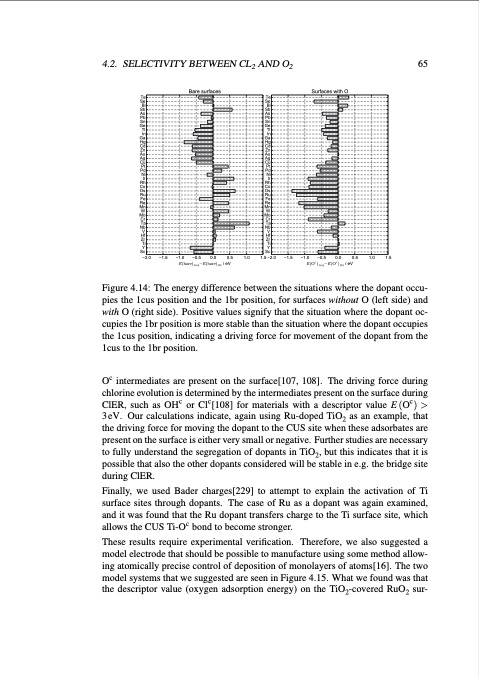
4.2. SELECTIVITY BETWEEN CL2 AND O2 65 Bare surfaces Te Se Bi Sb As Pb Sn Ge Tl In Ga Hg Cd Zn Au Ag Cu Pt Pd Ni Ir Rh Co Os Ru Fe Re Mn WW Mo Mo Cr Cr Ta Ta Nb Nb VV Hf Hf Zr Zr Ti Ti YY Surfaces with O Te Se Bi Sb As Pb Sn Ge Tl In Ga Hg Cd Zn Au Ag Cu Pt Pd Ni Ir Rh Co Os Ru Fe Re Mn Sc 2.0 1.5 1.0 0.5 0.0 0.5 1.0 E(bare)1cus−E(bare)1br / eV Sc 1.5 2.0 1.5 1.0 E(Oc )1cus−E(Oc )1br / eV 1.0 1.5 0.5 0.0 0.5 Figure 4.14: The energy difference between the situations where the dopant occu- pies the 1cus position and the 1br position, for surfaces without O (left side) and with O (right side). Positive values signify that the situation where the dopant oc- cupies the 1br position is more stable than the situation where the dopant occupies the 1cus position, indicating a driving force for movement of the dopant from the 1cus to the 1br position. Oc intermediates are present on the surface[107, 108]. The driving force during chlorine evolution is determined by the intermediates present on the surface during ClER, such as OHc or Clc[108] for materials with a descriptor value E (Oc) > 3eV. Our calculations indicate, again using Ru-doped TiO2 as an example, that the driving force for moving the dopant to the CUS site when these adsorbates are present on the surface is either very small or negative. Further studies are necessary to fully understand the segregation of dopants in TiO2, but this indicates that it is possible that also the other dopants considered will be stable in e.g. the bridge site during ClER. Finally, we used Bader charges[229] to attempt to explain the activation of Ti surface sites through dopants. The case of Ru as a dopant was again examined, and it was found that the Ru dopant transfers charge to the Ti surface site, which allows the CUS Ti-Oc bond to become stronger. These results require experimental verification. Therefore, we also suggested a model electrode that should be possible to manufacture using some method allow- ing atomically precise control of deposition of monolayers of atoms[16]. The two model systems that we suggested are seen in Figure 4.15. What we found was that the descriptor value (oxygen adsorption energy) on the TiO2-covered RuO2 sur-PDF Image | Studies of Electrode Processes in Industrial Electrosynthesis
PDF Search Title:
Studies of Electrode Processes in Industrial ElectrosynthesisOriginal File Name Searched:
electrosynthesis.pdfDIY PDF Search: Google It | Yahoo | Bing
Salgenx Redox Flow Battery Technology: Power up your energy storage game with Salgenx Salt Water Battery. With its advanced technology, the flow battery provides reliable, scalable, and sustainable energy storage for utility-scale projects. Upgrade to a Salgenx flow battery today and take control of your energy future.
| CONTACT TEL: 608-238-6001 Email: greg@salgenx.com | RSS | AMP |