PDF Publication Title:
Text from PDF Page: 079
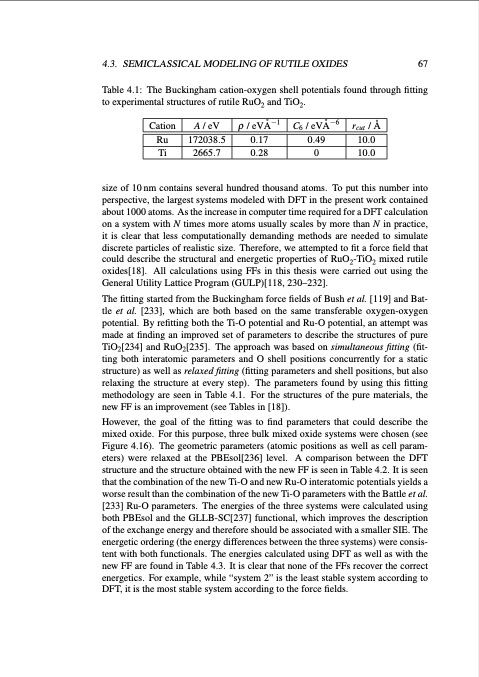
4.3. SEMICLASSICALMODELINGOFRUTILEOXIDES 67 Table 4.1: The Buckingham cation-oxygen shell potentials found through fitting to experimental structures of rutile RuO2 and TiO2. Cation Ru Ti A / eV 172038.5 2665.7 ρ / eVA ̊ −1 0.17 0.28 C6 / eVA ̊ −6 0.49 0 rcut / Å 10.0 10.0 size of 10 nm contains several hundred thousand atoms. To put this number into perspective, the largest systems modeled with DFT in the present work contained about 1000 atoms. As the increase in computer time required for a DFT calculation on a system with N times more atoms usually scales by more than N in practice, it is clear that less computationally demanding methods are needed to simulate discrete particles of realistic size. Therefore, we attempted to fit a force field that could describe the structural and energetic properties of RuO2-TiO2 mixed rutile oxides[18]. All calculations using FFs in this thesis were carried out using the General Utility Lattice Program (GULP)[118, 230–232]. The fitting started from the Buckingham force fields of Bush et al. [119] and Bat- tle et al. [233], which are both based on the same transferable oxygen-oxygen potential. By refitting both the Ti-O potential and Ru-O potential, an attempt was made at finding an improved set of parameters to describe the structures of pure TiO2[234] and RuO2[235]. The approach was based on simultaneous fitting (fit- ting both interatomic parameters and O shell positions concurrently for a static structure) as well as relaxed fitting (fitting parameters and shell positions, but also relaxing the structure at every step). The parameters found by using this fitting methodology are seen in Table 4.1. For the structures of the pure materials, the new FF is an improvement (see Tables in [18]). However, the goal of the fitting was to find parameters that could describe the mixed oxide. For this purpose, three bulk mixed oxide systems were chosen (see Figure 4.16). The geometric parameters (atomic positions as well as cell param- eters) were relaxed at the PBEsol[236] level. A comparison between the DFT structure and the structure obtained with the new FF is seen in Table 4.2. It is seen that the combination of the new Ti-O and new Ru-O interatomic potentials yields a worse result than the combination of the new Ti-O parameters with the Battle et al. [233] Ru-O parameters. The energies of the three systems were calculated using both PBEsol and the GLLB-SC[237] functional, which improves the description of the exchange energy and therefore should be associated with a smaller SIE. The energetic ordering (the energy differences between the three systems) were consis- tent with both functionals. The energies calculated using DFT as well as with the new FF are found in Table 4.3. It is clear that none of the FFs recover the correct energetics. For example, while “system 2” is the least stable system according to DFT, it is the most stable system according to the force fields.PDF Image | Studies of Electrode Processes in Industrial Electrosynthesis
PDF Search Title:
Studies of Electrode Processes in Industrial ElectrosynthesisOriginal File Name Searched:
electrosynthesis.pdfDIY PDF Search: Google It | Yahoo | Bing
Salgenx Redox Flow Battery Technology: Power up your energy storage game with Salgenx Salt Water Battery. With its advanced technology, the flow battery provides reliable, scalable, and sustainable energy storage for utility-scale projects. Upgrade to a Salgenx flow battery today and take control of your energy future.
CONTACT TEL: 608-238-6001 Email: greg@salgenx.com (Standard Web Page)