
PDF Publication Title:
Text from PDF Page: 085
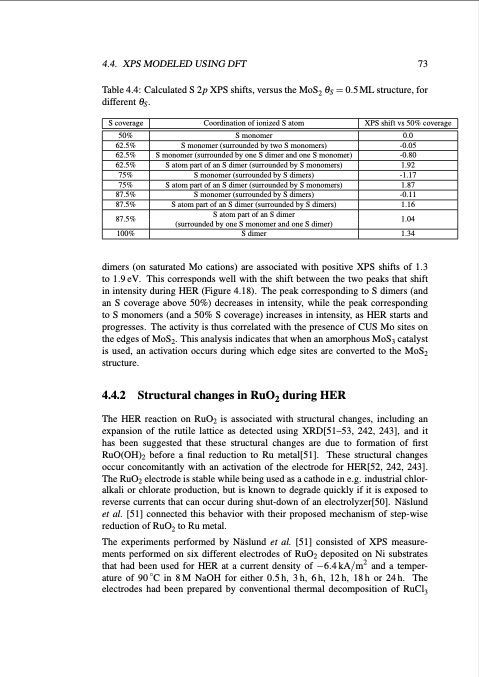
4.4. XPSMODELEDUSINGDFT 73 Table 4.4: Calculated S 2p XPS shifts, versus the MoS2 θS = 0.5ML structure, for different θS. S coverage 50% 62.5% 62.5% 62.5% 75% 75% 87.5% 87.5% 87.5% 100% Coordination of ionized S atom S monomer S monomer (surrounded by two S monomers) S monomer (surrounded by one S dimer and one S monomer) S atom part of an S dimer (surrounded by S monomers) S monomer (surrounded by S dimers) S atom part of an S dimer (surrounded by S monomers) S monomer (surrounded by S dimers) S atom part of an S dimer (surrounded by S dimers) S atom part of an S dimer (surrounded by one S monomer and one S dimer) S dimer XPS shift vs 50% coverage 0.0 -0.05 -0.80 1.92 -1.17 1.87 -0.11 1.16 1.04 1.34 dimers (on saturated Mo cations) are associated with positive XPS shifts of 1.3 to 1.9 eV. This corresponds well with the shift between the two peaks that shift in intensity during HER (Figure 4.18). The peak corresponding to S dimers (and an S coverage above 50%) decreases in intensity, while the peak corresponding to S monomers (and a 50% S coverage) increases in intensity, as HER starts and progresses. The activity is thus correlated with the presence of CUS Mo sites on the edges of MoS2. This analysis indicates that when an amorphous MoS3 catalyst is used, an activation occurs during which edge sites are converted to the MoS2 structure. 4.4.2 Structural changes in RuO2 during HER The HER reaction on RuO2 is associated with structural changes, including an expansion of the rutile lattice as detected using XRD[51–53, 242, 243], and it has been suggested that these structural changes are due to formation of first RuO(OH)2 before a final reduction to Ru metal[51]. These structural changes occur concomitantly with an activation of the electrode for HER[52, 242, 243]. The RuO2 electrode is stable while being used as a cathode in e.g. industrial chlor- alkali or chlorate production, but is known to degrade quickly if it is exposed to reverse currents that can occur during shut-down of an electrolyzer[50]. Näslund et al. [51] connected this behavior with their proposed mechanism of step-wise reduction of RuO2 to Ru metal. The experiments performed by Näslund et al. [51] consisted of XPS measure- ments performed on six different electrodes of RuO2 deposited on Ni substrates that had been used for HER at a current density of −6.4 kA/m2 and a temper- ature of 90◦C in 8M NaOH for either 0.5h, 3h, 6h, 12h, 18h or 24h. The electrodes had been prepared by conventional thermal decomposition of RuCl3PDF Image | Studies of Electrode Processes in Industrial Electrosynthesis
PDF Search Title:
Studies of Electrode Processes in Industrial ElectrosynthesisOriginal File Name Searched:
electrosynthesis.pdfDIY PDF Search: Google It | Yahoo | Bing
Salgenx Redox Flow Battery Technology: Power up your energy storage game with Salgenx Salt Water Battery. With its advanced technology, the flow battery provides reliable, scalable, and sustainable energy storage for utility-scale projects. Upgrade to a Salgenx flow battery today and take control of your energy future.
| CONTACT TEL: 608-238-6001 Email: greg@salgenx.com | RSS | AMP |