PDF Publication Title:
Text from PDF Page: 019
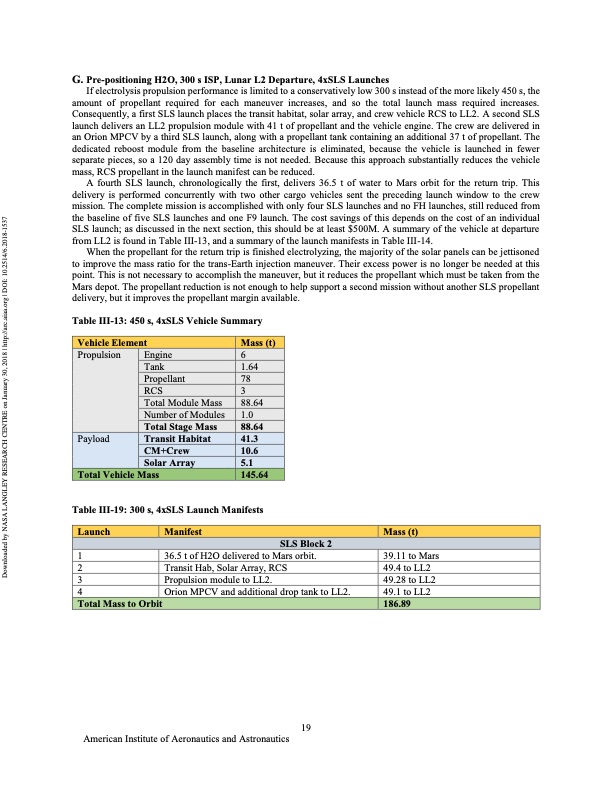
G. Pre-positioning H2O, 300 s ISP, Lunar L2 Departure, 4xSLS Launches If electrolysis propulsion performance is limited to a conservatively low 300 s instead of the more likely 450 s, the amount of propellant required for each maneuver increases, and so the total launch mass required increases. Consequently, a first SLS launch places the transit habitat, solar array, and crew vehicle RCS to LL2. A second SLS launch delivers an LL2 propulsion module with 41 t of propellant and the vehicle engine. The crew are delivered in an Orion MPCV by a third SLS launch, along with a propellant tank containing an additional 37 t of propellant. The dedicated reboost module from the baseline architecture is eliminated, because the vehicle is launched in fewer separate pieces, so a 120 day assembly time is not needed. Because this approach substantially reduces the vehicle mass, RCS propellant in the launch manifest can be reduced. A fourth SLS launch, chronologically the first, delivers 36.5 t of water to Mars orbit for the return trip. This delivery is performed concurrently with two other cargo vehicles sent the preceding launch window to the crew mission. The complete mission is accomplished with only four SLS launches and no FH launches, still reduced from the baseline of five SLS launches and one F9 launch. The cost savings of this depends on the cost of an individual SLS launch; as discussed in the next section, this should be at least $500M. A summary of the vehicle at departure from LL2 is found in Table III-13, and a summary of the launch manifests in Table III-14. When the propellant for the return trip is finished electrolyzing, the majority of the solar panels can be jettisoned to improve the mass ratio for the trans-Earth injection maneuver. Their excess power is no longer be needed at this point. This is not necessary to accomplish the maneuver, but it reduces the propellant which must be taken from the Mars depot. The propellant reduction is not enough to help support a second mission without another SLS propellant delivery, but it improves the propellant margin available. Table III-13: 450 s, 4xSLS Vehicle Summary Vehicle Element Mass (t) Propulsion Engine 6 Tank 1.64 Propellant 78 RCS 3 Total Module Mass 88.64 Number of Modules 1.0 Total Stage Mass 88.64 Payload Transit Habitat 41.3 CM+Crew 10.6 Solar Array 5.1 Total Vehicle Mass 145.64 Table III-19: 300 s, 4xSLS Launch Manifests Launch Manifest Mass (t) SLS Block 2 1 36.5 t of H2O delivered to Mars orbit. 39.11 to Mars 2 Transit Hab, Solar Array, RCS 49.4 to LL2 3 Propulsion module to LL2. 49.28 to LL2 4 Orion MPCV and additional drop tank to LL2. 49.1 to LL2 Total Mass to Orbit 186.89 19 American Institute of Aeronautics and Astronautics Downloaded by NASA LANGLEY RESEARCH CENTRE on January 30, 2018 | http://arc.aiaa.org | DOI: 10.2514/6.2018-1537PDF Image | Water Electrolysis for Propulsion of a Crewed Mars
PDF Search Title:
Water Electrolysis for Propulsion of a Crewed MarsOriginal File Name Searched:
water-electrolysis-propulsion.pdfDIY PDF Search: Google It | Yahoo | Bing
Salgenx Redox Flow Battery Technology: Power up your energy storage game with Salgenx Salt Water Battery. With its advanced technology, the flow battery provides reliable, scalable, and sustainable energy storage for utility-scale projects. Upgrade to a Salgenx flow battery today and take control of your energy future.
CONTACT TEL: 608-238-6001 Email: greg@salgenx.com (Standard Web Page)