PDF Publication Title:
Text from PDF Page: 151
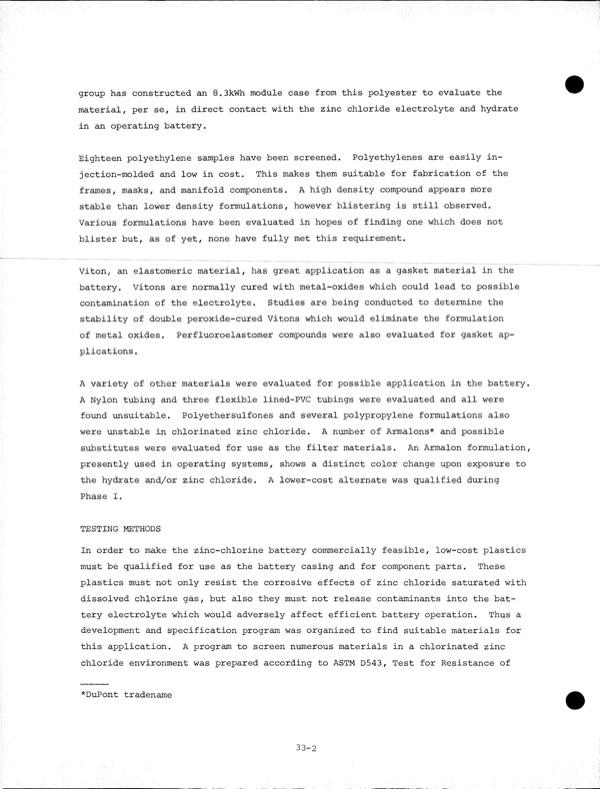
group has constructed an 8.3kWh module case from this polyester to evaluate the material, per se, in direct contact with the zinc chloride electrolyte and hydrate in an operating battery. Eighteen polyethylene samples have been screened. Polyethylenes are easily in jection-molded and low in cost. This makes them suitable for fabrication of the frames, masks, and manifold components. A high density compound appears more stable than lower density formulations, however blistering is still observed. Various formulations have been evaluated in hopes of finding one which does not blister but, as of yet, none have fully met this requirement. Viton, an elastomeric material, has great application as a gasket material in the battery. Vitons are normally cured with metal-oxides which could lead to possible contamination of the electrolyte. Studies are being conducted to determine the stability of double peroxide-cured Vitons which would eliminate the formulation of metal oxides. Perfluoroelastomer compounds were also evaluated for gasket ap plications . A variety of other materials were evaluated for possible application in the battery. A Nylon tubing and three flexible lined-PVC tubings were evaluated and all were found unsuitable. Polyethersulfones and several polypropylene formulations also were unstable in chlorinated zinc chloride. A number of Armalons* and possible substitutes were evaluated for use as the filter materials. An Armalon formulation, presently used in operating systems, shows a distinct color change upon exposure to the hydrate and/or zinc chloride. A lower-cost alternate was qualified during Phase X. TESTING METHODS In order to make the zinc-chlorine battery commercially feasible, low-cost plastics must be qualified for use as the battery casing and for component parts. These plastics must not only resist the corrosive effects of zinc chloride saturated with dissolved chlorine gas, but also they must not release contaminants into the bat teryelectrolytewhichwouldadverselyaffectefficientbatteryoperation. Thusa development and specification program was organized to find suitable materials for this application. A program to screen numerous materials in a chlorinated zinc chloride environment was prepared according to ASTM D543, Test for Resistance of *DuPont tradename 33-2PDF Image | Development of the Zinc-Chlorine Battery for Utility
PDF Search Title:
Development of the Zinc-Chlorine Battery for UtilityOriginal File Name Searched:
6302789.pdfDIY PDF Search: Google It | Yahoo | Bing
Salgenx Redox Flow Battery Technology: Power up your energy storage game with Salgenx Salt Water Battery. With its advanced technology, the flow battery provides reliable, scalable, and sustainable energy storage for utility-scale projects. Upgrade to a Salgenx flow battery today and take control of your energy future.
| CONTACT TEL: 608-238-6001 Email: greg@salgenx.com | RSS | AMP |