
PDF Publication Title:
Text from PDF Page: 173
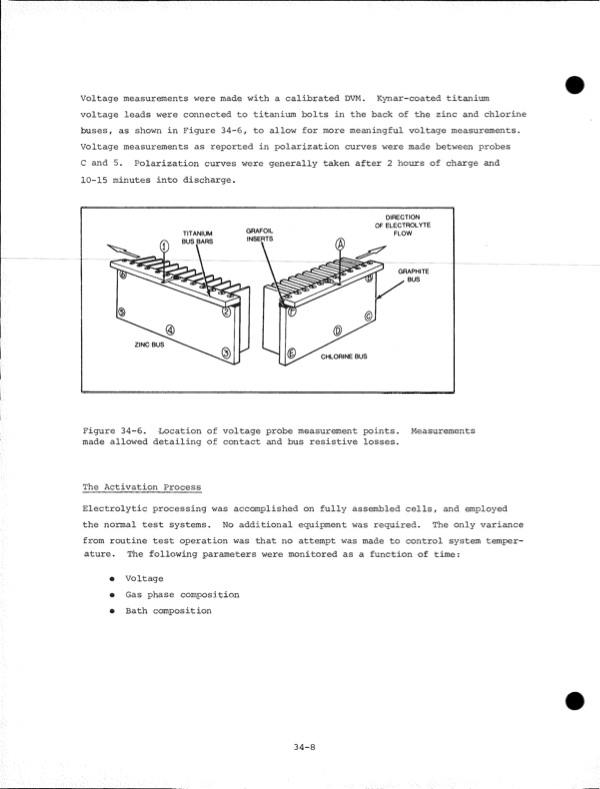
VoltagemeasurementsweremadewithacalibratedDVM. Kynar-coatedtitanium voltage leads were connected to titanium bolts in the back of the zinc and chlorine buses, as shown in Figure 34-6, to allow for more meaningful voltage measurements. Voltage measurements as reported in polarization curves were made between probes 0 and 5. Polarization curves were generally taken after 2 hours of charge and 10-15 minutes into discharge. ZINC BUS TITANIUM BUS BARS GRAFOIL INSERTS DIRECTION OF ELECTROLYTE FLOW GRAPHITE . BUS Figure 34-6. Location of voltage probe measurement points. Measurements made allowed detailing of contact and bus resistive losses. The Activation Process* • Electrolytic processing was accomplished on fully assembled cells, and employed the normal test systems. No additional equipment was required. The only variance from routine test operation was that no attempt was made to control system temper ature. Thefollowingparametersweremonitoredasafunctionoftime: ® Voltage • Gas phase composition • Bath composition 34-8 CHLORINE BUSPDF Image | Development of the Zinc-Chlorine Battery for Utility
PDF Search Title:
Development of the Zinc-Chlorine Battery for UtilityOriginal File Name Searched:
6302789.pdfDIY PDF Search: Google It | Yahoo | Bing
Salgenx Redox Flow Battery Technology: Power up your energy storage game with Salgenx Salt Water Battery. With its advanced technology, the flow battery provides reliable, scalable, and sustainable energy storage for utility-scale projects. Upgrade to a Salgenx flow battery today and take control of your energy future.
| CONTACT TEL: 608-238-6001 Email: greg@salgenx.com | RSS | AMP |