
PDF Publication Title:
Text from PDF Page: 209
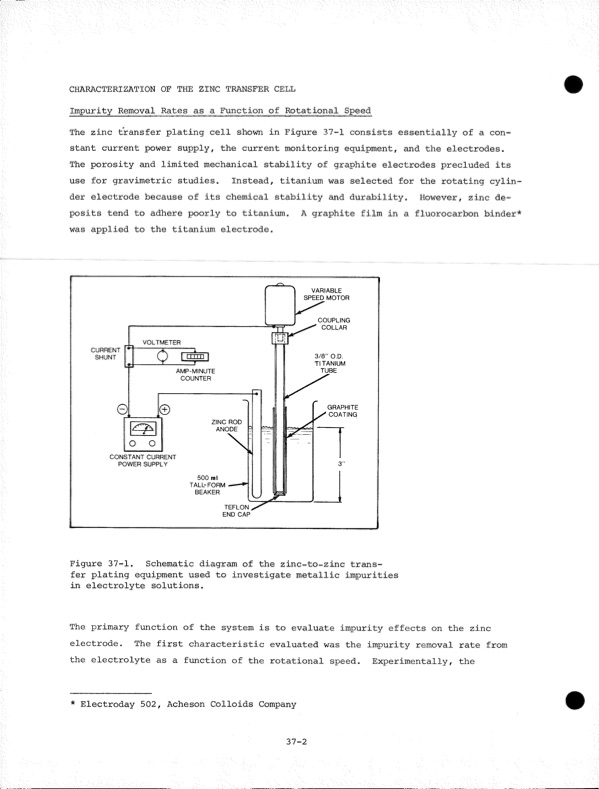
CHARACTERIZATION OF THE ZINC TRANSFER CELL Impurity Removal Rates as a Function of Rotational Speed The zinc transfer plating cell shown in Figure 37-1 consists essentially of a con stant current power supply, the current monitoring equipment, and the electrodes. The porosity and limited mechanical stability of graphite electrodes precluded its use for gravimetric studies. Instead, titanium was selected for the rotating cylin der electrode because of its chemical stability and durability. However, zinc de posits tend to adhere poorly to titanium. A graphite film in a fluorocarbon binder* was applied to the titanium electrode. CURRENT SHUNT CONSTANT CURRENT POWER SUPPLY n mi [ AMP-MINUTE COUNTER ZINC ROD ANODE 500 ml TALL-FORM BEAKER TEFLON , END CAP VOLTMETER VARIABLE SPEED MOTOR COUPLING COLLAR 3/8'' O.D. TITANIUM TUBE GRAPHITE COATING Schematic diagram of the zinc-to-zinc trans Figure 37-1. fer plating equipment used to investigate metallic impurities in electrolyte solutions. The primary function of the system is to evaluate impurity effects on the zinc electrode. The first characteristic evaluated was the impurity removal rate from the electrolyte as a function of the rotational speed. Experimentally, the * Electroday 502, Acheson Colloids Company 37-2PDF Image | Development of the Zinc-Chlorine Battery for Utility
PDF Search Title:
Development of the Zinc-Chlorine Battery for UtilityOriginal File Name Searched:
6302789.pdfDIY PDF Search: Google It | Yahoo | Bing
Salgenx Redox Flow Battery Technology: Power up your energy storage game with Salgenx Salt Water Battery. With its advanced technology, the flow battery provides reliable, scalable, and sustainable energy storage for utility-scale projects. Upgrade to a Salgenx flow battery today and take control of your energy future.
| CONTACT TEL: 608-238-6001 Email: greg@salgenx.com | RSS | AMP |