
PDF Publication Title:
Text from PDF Page: 309
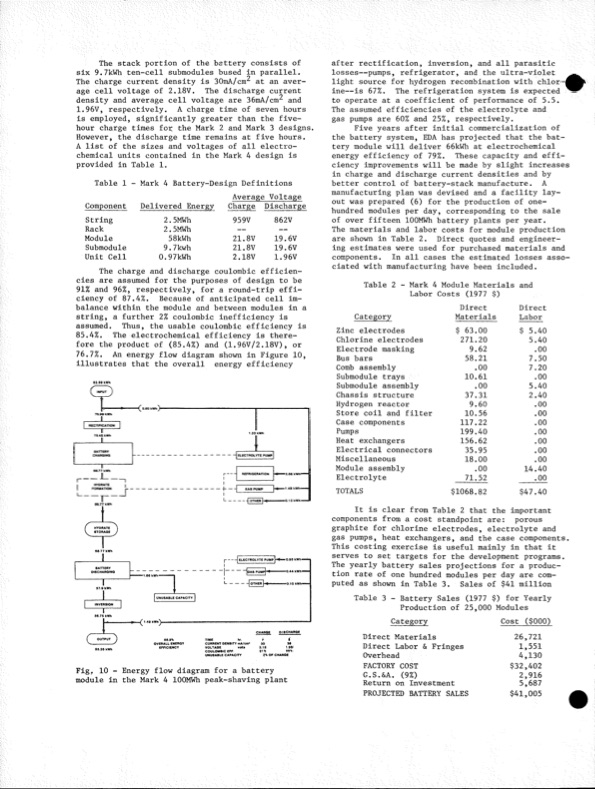
The stack portion of the battery consists of six 9.7kWh ten-cell submodules bused in parallel. The charge current density is SOmA/cm^ at an aver agecellvoltageof2.18V. Thedischargecurrent density and average cell voltage are 36mA/cm^ and 1.96V, respectively. A charge time of seven hours is employed, significantly greater than the five- hour charge times for the Mark 2 and Mark 3 designs. However, the discharge time remains at five hours. A list of the sizes and voltages of all electro chemicalunitscontainedintheMark4designis after rectification, inversion, and all parasitic losses—pumps, refrigerator, and the ultra-violet light source for hydrogen recombination with chlor ine—is67%. Therefrigerationsystemisexpected to operate at a coefficient of performance of 5.5. The assumed efficiencies of the electrolyte and gas pumps are 60% and 25%, respectively. Five years after initial commercialization of the battery system, EDA has projected that the bat tery module will deliver 66kWh at electrochemical energyefficiencyof79%. Thesecapacityandeffi ciency improvements will be made by slight increases in charge and discharge current densities and by better control of battery-stack manufacture. A manufacturing plan was devised and a facility lay out was prepared (6) for the production of one- hundred modules per day, corresponding to the sale of over fifteen lOOMWh battery plants per year. The materials and labor costs for module production are shown in Table 2. Direct quotes and engineer ing estimates were used for purchased materials and components. In all cases the estimated losses asso ciated with manufacturing have been included. Table 2 - Mark 4 Module Materials and Labor Costs (1977 $) provided in Table 1 Component String Rack Module Submodule Unit Cell Table 1. - Mark 4 Battery-Design Definitions Average Voltage Delivered Energy Charge Discharge 2.5MWh 959V 862V 2.5MWh —— 58kWh 21.8V 19.6V 9.7kwh 21.8V 19.6V 0.97kWh 2.18V 1.96V The charge and discharge coulombic efficien cies are assumed for the purposes of design to be 91% and 96%, respectively, for a round-trip effi ciency of 87.4%. Because of anticipated cell im balance within the module and between modules in a string, a further 2% coulombic inefficiency is assumed. Thus, the usable coulombic efficiency is 85.4%. The electrochemical efficiency is there fore the product of (85.4%) and (1.96V/2.18V), or 76.7%. AnenergyflowdiagramshowninFigure10, illustrates that the overall energy efficiency Direct Category Materials Zinc electrodes $ 63.00 Chlorine electrodes 271.20 Electrode masking 9.62 Bus bars 58.21 Comb assembly .00 Submodule trays 10.61 Submodule assembly .00 Chassis structure 37.31 Hydrogen reactor 9.60 Store coil and filter 10.56 Case components 117.22 Pumps 199.40 Heat exchangers 156.62 Electrical connectors 35.95 Miscellaneous 18.00 Module assembly .00 Electrolyte 71.52 TOTALS $1068.82 Direct Labor $ 5.40 5.40 .00 7.50 7.20 .00 5.40 2.40 .00 .00 .00 .00 .00 .00 .00 14.40 .00 $47.40 82.59 kWh I RECTIFICATION --1--- ( HYDBATE ) V STORAGE J \ 57.9 kWh INVERSION \ 55.28 kWh ■^S.60 kWh)1 | H.. UNUSABLE CAPACITY ^ 1.49 kWh)_ 86.9% OVERALL ENERGY EFFICIENCY r~---- j ELECTROLYTE PUmV| |oAS PUMpj * »h 1. Fig. 10 - Energy flow diagram for a battery module in the Mark 4 lOOMWh peak-shaving plant CURRENT DENSITY mA/Cffl1 VOLTAGE volt* COULOMBIC EFF. UNUSABLE CAPACITY 2% OF CHARGE 0-95 kWh— ' 0 ** kWh— --------------|0THEB|<"'■.............0.10kWh— It is clear from Table 2 that the important components from a cost standpoint are: porous graphite for chlorine electrodes, electrolyte and gas pumps, heat exchangers, and the case components. This costing exercise is useful mainly in that it serves to set targets for the development programs. The yearly battery sales projections for a produc tion rate of one hundred modules per day are com putedasshowninTable3. Salesof$41million Table 3 - Battery Sales (1977 $) for Yearly Production of 25,000 Modules CHARGE DISCHARGE Category Direct Materials Direct Labor & Fringes Overhead FACTORY COST G.S.&A. (9%) Return on Investment PROJECTED BATTERY SALES Cost ($000) 26,721 1,551 4,130 $32,402 2,916 5,687 $41,005PDF Image | Development of the Zinc-Chlorine Battery for Utility
PDF Search Title:
Development of the Zinc-Chlorine Battery for UtilityOriginal File Name Searched:
6302789.pdfDIY PDF Search: Google It | Yahoo | Bing
Salgenx Redox Flow Battery Technology: Power up your energy storage game with Salgenx Salt Water Battery. With its advanced technology, the flow battery provides reliable, scalable, and sustainable energy storage for utility-scale projects. Upgrade to a Salgenx flow battery today and take control of your energy future.
| CONTACT TEL: 608-238-6001 Email: greg@salgenx.com | RSS | AMP |