PDF Publication Title:
Text from PDF Page: 310
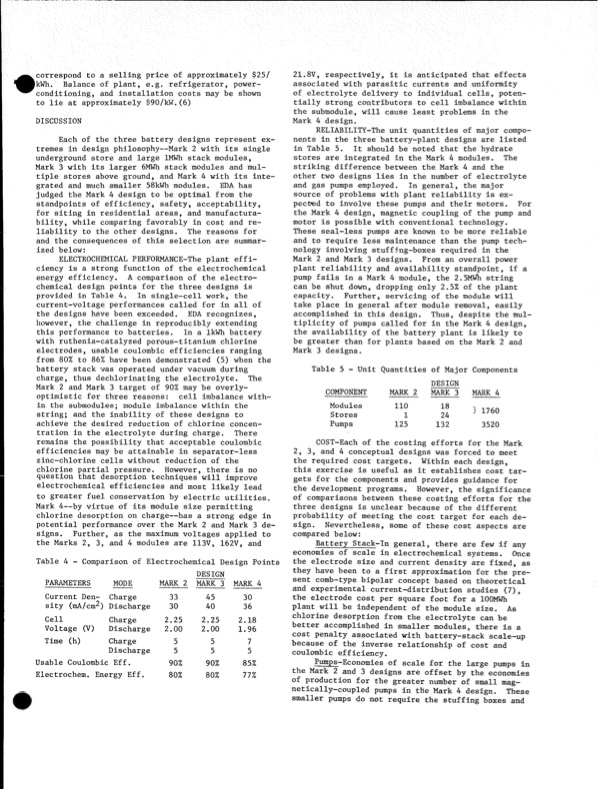
correspond to a selling price of approximately $25/ kWh. Balance of plant, e.g. refrigerator, power conditioning, and installation costs may be shown to lie at approximately $90/kW.(6) DISCUSSION Each of the three battery designs represent ex tremes in design philosophy—Mark 2 with its single underground store and large IMWh stack modules, Mark 3 with its larger 6MWh stack modules and mul tiple stores above ground, and Mark 4 with its inte gratedandmuchsmaller58kWhmodules. EDAhas judged the Mark 4 design to be optimal from the standpoints of efficiency, safety, acceptability, for siting in residential areas, and manufactura bility, while comparing favorably in cost and re liability to the other designs. The reasons for and the consequences of this selection are summar ized below: ELECTROCHEMICAL PERFORMANCE-The plant effi ciency is a strong function of the electrochemical energy efficiency. A comparison of the electro chemical design points for the three designs is provided in Table 4. In single-cell work, the current-voltage performances called for in all of the designs have been exceeded. EDA recognizes, however, the challenge in reproducibly extending thisperformancetobatteries. InaIkWhbattery with ruthenia-catalyzed porous-titanium chlorine electrodes, usable coulombic efficiencies ranging from 80% to 86% have been demonstrated (5) when the battery stack was operated under vacuum during charge, thus dechlorinating the electrolyte. The Mark 2 and Mark 3 target of 90% may be overly- optimistic for three reasons: cell imbalance with in the submodules; module imbalance within the string; and the inability of these designs to achieve the desired reduction of chlorine concen trationintheelectrolyteduringcharge. There remains the possibility that acceptable coulombic efficiencies may be attainable in separator-less zinc-chlorine cells without reduction of the chlorine partial pressure. However, there is no question that desorption techniques will improve electrochemical efficiencies and most likely lead to greater fuel conservation by electric utilities. Mark 4—by virtue of its module size permitting chlorine desorption on charge—has a strong edge in potential performance over the Mark 2 and Mark 3 de signs. Further, as the maximum voltages applied to the Marks 2, 3, and 4 modules are 113V, 162V, and Table 4 - Comparison of Electrochemical Design Points DESIGN 21.8V, respectively, it is anticipated that effects associated with parasitic currents and uniformity of electrolyte delivery to individual cells, poten tially strong contributors to cell imbalance within the submodule, will cause least problems in the Mark 4 design. RELIABILITY-The unit quantities of major compo nents in the three battery-plant designs are listed in Table 5. It should be noted that the hydrate stores are integrated in the Mark 4 modules. The striking difference between the Mark 4 and the other two designs lies in the number of electrolyte andgaspumpsemployed. Ingeneral,themajor source of problems with plant reliability is ex pected to involve these pumps and their motors. For the Mark 4 design, magnetic coupling of the pump and motor is possible with conventional technology. These seal-less pumps are known to be more reliable and to require less maintenance than the pump tech nology involving stuffing-boxes required in the Mark 2 and Mark 3 designs. From an overall power plant reliability and availability standpoint, if a pump fails in a Mark 4 module, the 2.5MWh string can be shut down, dropping only 2.5% of the plant capacity. Further, servicing of the module will take place in general after module removal, easily accomplished in this design. Thus, despite the mul tiplicity of pumps called for in the Mark 4 design, theavailabilityofthebatteryplantislikelyto be greater than for plants based on the Mark 2 and Mark 3 designs. Table 5 - Unit Quantities of Major Components DESIGN PARAMETERS MODE CurrentDen- Charge sity (mA/cm^) Discharge MARK 2 MARK 3 MARK . COST-Each of the costing efforts for the Mark 2, 3, and 4 conceptual designs was forced to meet the required cost targets. Within each design, this exercise is useful as it establishes cost tar gets for the components and provides guidance for the development programs. However, the significance of comparisons between these costing efforts for the three designs is unclear because of the different probability of meeting the cost target for each de sign. Nevertheless, some of these cost aspects are compared below: Battery Stack-In general, there are few if any economies of scale in electrochemical systems. Once the electrode size and current density are fixed, as they have been to a first approximation for the pre sent comb-type bipolar concept based on theoretical and experimental current-distribution studies (7), the electrode cost per square foot for a lOOMWh plant will be independent of the module size. As chlorine desorption from the electrolyte can be better accomplished in smaller modules, there is a cost penalty associated with battery-stack scale-up because of the inverse relationship of cost and coulombic efficiency. Fumps-Economies of scale for the large pumps in the Mark 2 and 3 designs are offset by the economies of production for the greater number of small mag netically-coupled pumps in the Mark 4 design. These smaller pumps do not require the stuffing boxes and Cell Voltage (V) Time (h) Charge Discharge Charge Discharge 33 30 2.25 2.00 5 5 90% 80% 45 30 40 36 2.25 2.18 2.00 1.96 5 7 5 5 90% 85% 80% 77% Usable Coulombic Eff. Electrochem. Energy Eff. COMPONENT Modules Stores Pumps MARK 2 110 1 125 MARK 3 18 24 132 MARK 4 } 1760 3520PDF Image | Development of the Zinc-Chlorine Battery for Utility
PDF Search Title:
Development of the Zinc-Chlorine Battery for UtilityOriginal File Name Searched:
6302789.pdfDIY PDF Search: Google It | Yahoo | Bing
Salgenx Redox Flow Battery Technology: Power up your energy storage game with Salgenx Salt Water Battery. With its advanced technology, the flow battery provides reliable, scalable, and sustainable energy storage for utility-scale projects. Upgrade to a Salgenx flow battery today and take control of your energy future.
CONTACT TEL: 608-238-6001 Email: greg@salgenx.com (Standard Web Page)