PDF Publication Title:
Text from PDF Page: 005
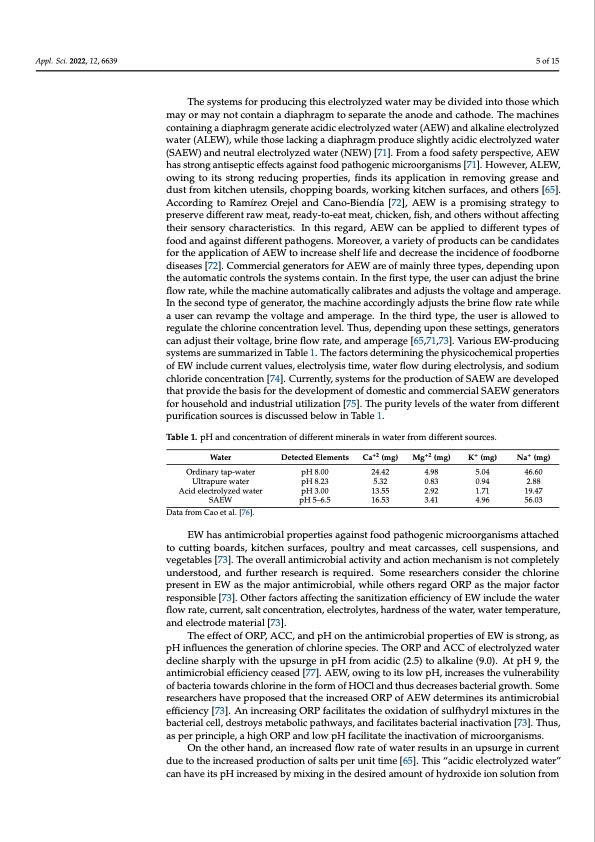
Appl. Sci. 2022, 12, 6639 5 of 15 The systems for producing this electrolyzed water may be divided into those which may or may not contain a diaphragm to separate the anode and cathode. The machines containing a diaphragm generate acidic electrolyzed water (AEW) and alkaline electrolyzed water (ALEW), while those lacking a diaphragm produce slightly acidic electrolyzed water (SAEW) and neutral electrolyzed water (NEW) [71]. From a food safety perspective, AEW has strong antiseptic effects against food pathogenic microorganisms [71]. However, ALEW, owing to its strong reducing properties, finds its application in removing grease and dust from kitchen utensils, chopping boards, working kitchen surfaces, and others [65]. According to Ramírez Orejel and Cano-Biendía [72], AEW is a promising strategy to preserve different raw meat, ready-to-eat meat, chicken, fish, and others without affecting their sensory characteristics. In this regard, AEW can be applied to different types of food and against different pathogens. Moreover, a variety of products can be candidates for the application of AEW to increase shelf life and decrease the incidence of foodborne diseases [72]. Commercial generators for AEW are of mainly three types, depending upon the automatic controls the systems contain. In the first type, the user can adjust the brine flow rate, while the machine automatically calibrates and adjusts the voltage and amperage. In the second type of generator, the machine accordingly adjusts the brine flow rate while a user can revamp the voltage and amperage. In the third type, the user is allowed to regulate the chlorine concentration level. Thus, depending upon these settings, generators can adjust their voltage, brine flow rate, and amperage [65,71,73]. Various EW-producing systems are summarized in Table 1. The factors determining the physicochemical properties of EW include current values, electrolysis time, water flow during electrolysis, and sodium chloride concentration [74]. Currently, systems for the production of SAEW are developed that provide the basis for the development of domestic and commercial SAEW generators for household and industrial utilization [75]. The purity levels of the water from different purification sources is discussed below in Table 1. Table 1. pH and concentration of different minerals in water from different sources. Water Ordinary tap-water Ultrapure water Acid electrolyzed water SAEW Data from Cao et al. [76]. Detected Elements pH 8.00 pH 8.23 pH 3.00 pH 5–6.5 Ca+2 (mg) 24.42 5.32 13.55 16.53 Mg+2 (mg) 4.98 0.83 2.92 3.41 K+ (mg) 5.04 0.94 1.71 4.96 Na+ (mg) 46.60 2.88 19.47 56.03 EW has antimicrobial properties against food pathogenic microorganisms attached to cutting boards, kitchen surfaces, poultry and meat carcasses, cell suspensions, and vegetables [73]. The overall antimicrobial activity and action mechanism is not completely understood, and further research is required. Some researchers consider the chlorine present in EW as the major antimicrobial, while others regard ORP as the major factor responsible [73]. Other factors affecting the sanitization efficiency of EW include the water flow rate, current, salt concentration, electrolytes, hardness of the water, water temperature, and electrode material [73]. The effect of ORP, ACC, and pH on the antimicrobial properties of EW is strong, as pH influences the generation of chlorine species. The ORP and ACC of electrolyzed water decline sharply with the upsurge in pH from acidic (2.5) to alkaline (9.0). At pH 9, the antimicrobial efficiency ceased [77]. AEW, owing to its low pH, increases the vulnerability of bacteria towards chlorine in the form of HOCl and thus decreases bacterial growth. Some researchers have proposed that the increased ORP of AEW determines its antimicrobial efficiency [73]. An increasing ORP facilitates the oxidation of sulfhydryl mixtures in the bacterial cell, destroys metabolic pathways, and facilitates bacterial inactivation [73]. Thus, as per principle, a high ORP and low pH facilitate the inactivation of microorganisms. On the other hand, an increased flow rate of water results in an upsurge in current due to the increased production of salts per unit time [65]. This “acidic electrolyzed water” can have its pH increased by mixing in the desired amount of hydroxide ion solution fromPDF Image | Electrolyzed Water in the Food Industry
PDF Search Title:
Electrolyzed Water in the Food IndustryOriginal File Name Searched:
applsci-12-06639-v2.pdfDIY PDF Search: Google It | Yahoo | Bing
Salgenx Redox Flow Battery Technology: Power up your energy storage game with Salgenx Salt Water Battery. With its advanced technology, the flow battery provides reliable, scalable, and sustainable energy storage for utility-scale projects. Upgrade to a Salgenx flow battery today and take control of your energy future.
CONTACT TEL: 608-238-6001 Email: greg@salgenx.com (Standard Web Page)