PDF Publication Title:
Text from PDF Page: 064
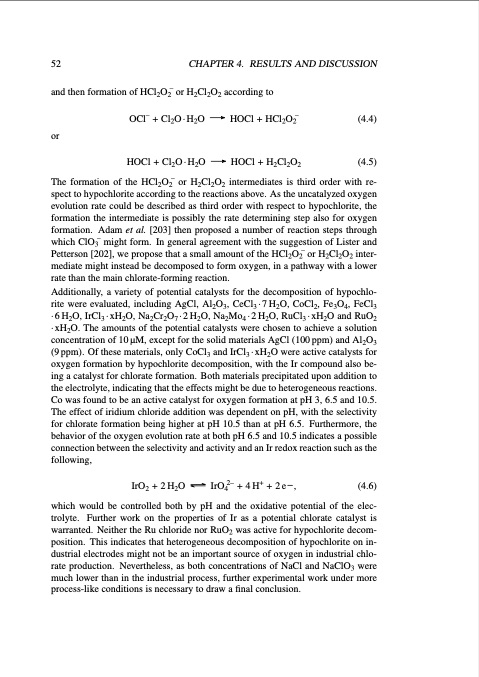
52 CHAPTER4. RESULTSANDDISCUSSION and then formation of HCl2O2– or H2Cl2O2 according to or OCl– + Cl2O·H2O HOCl + HCl2O2– (4.4) HOCl + Cl2O·H2O HOCl + H2Cl2O2 (4.5) The formation of the HCl2O2– or H2Cl2O2 intermediates is third order with re- spect to hypochlorite according to the reactions above. As the uncatalyzed oxygen evolution rate could be described as third order with respect to hypochlorite, the formation the intermediate is possibly the rate determining step also for oxygen formation. Adam et al. [203] then proposed a number of reaction steps through which ClO3– might form. In general agreement with the suggestion of Lister and Petterson [202], we propose that a small amount of the HCl2O2– or H2Cl2O2 inter- mediate might instead be decomposed to form oxygen, in a pathway with a lower rate than the main chlorate-forming reaction. Additionally, a variety of potential catalysts for the decomposition of hypochlo- rite were evaluated, including AgCl, Al2O3, CeCl3 · 7 H2O, CoCl2, Fe3O4, FeCl3 · 6 H2O, IrCl3 · xH2O, Na2Cr2O7 · 2 H2O, Na2Mo4 · 2 H2O, RuCl3 · xH2O and RuO2 · xH2O. The amounts of the potential catalysts were chosen to achieve a solution concentration of 10 μM, except for the solid materials AgCl (100 ppm) and Al2O3 (9 ppm). Of these materials, only CoCl3 and IrCl3 · xH2O were active catalysts for oxygen formation by hypochlorite decomposition, with the Ir compound also be- ing a catalyst for chlorate formation. Both materials precipitated upon addition to the electrolyte, indicating that the effects might be due to heterogeneous reactions. Co was found to be an active catalyst for oxygen formation at pH 3, 6.5 and 10.5. The effect of iridium chloride addition was dependent on pH, with the selectivity for chlorate formation being higher at pH 10.5 than at pH 6.5. Furthermore, the behavior of the oxygen evolution rate at both pH 6.5 and 10.5 indicates a possible connection between the selectivity and activity and an Ir redox reaction such as the following, IrO +2HO IrO2–+4H++2e , (4.6) 224 which would be controlled both by pH and the oxidative potential of the elec- trolyte. Further work on the properties of Ir as a potential chlorate catalyst is warranted. Neither the Ru chloride nor RuO2 was active for hypochlorite decom- position. This indicates that heterogeneous decomposition of hypochlorite on in- dustrial electrodes might not be an important source of oxygen in industrial chlo- rate production. Nevertheless, as both concentrations of NaCl and NaClO3 were much lower than in the industrial process, further experimental work under more process-like conditions is necessary to draw a final conclusion.PDF Image | Studies of Electrode Processes in Industrial Electrosynthesis
PDF Search Title:
Studies of Electrode Processes in Industrial ElectrosynthesisOriginal File Name Searched:
electrosynthesis.pdfDIY PDF Search: Google It | Yahoo | Bing
Salgenx Redox Flow Battery Technology: Power up your energy storage game with Salgenx Salt Water Battery. With its advanced technology, the flow battery provides reliable, scalable, and sustainable energy storage for utility-scale projects. Upgrade to a Salgenx flow battery today and take control of your energy future.
CONTACT TEL: 608-238-6001 Email: greg@salgenx.com (Standard Web Page)