PDF Publication Title:
Text from PDF Page: 306
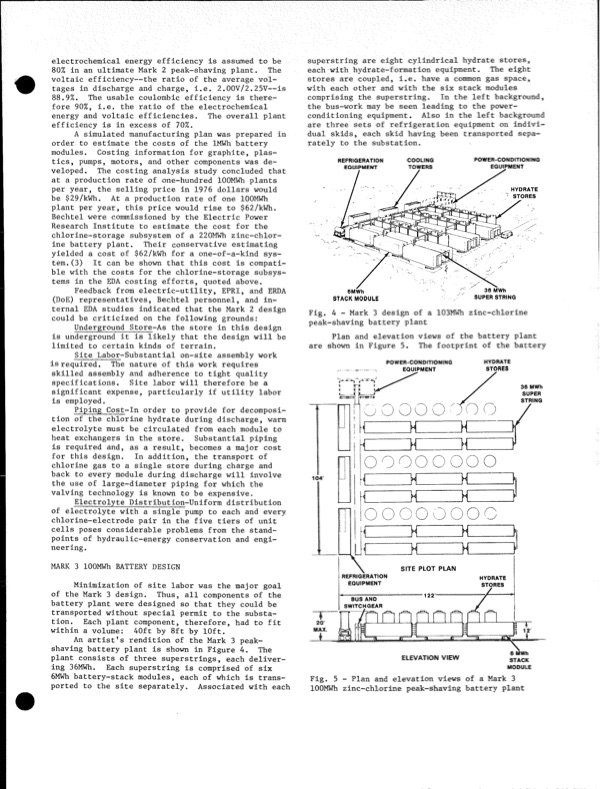
electrochemical energy efficiency is assumed to be 80%inanultimateMark2peak-shavingplant. The voltaic efficiency— the ratio of the average vol tages in discharge and charge, i.e. 2.00V/2.25V— is 88.9%. The usable coulombic efficiency is there fore 90%, i.e. the ratio of the electrochemical energy and voltaic efficiencies. The overall plant efficiency is in excess of 70%. A simulated manufacturing plan was prepared in order to estimate the costs of the IMWh battery modules. Costing information for graphite, plas tics, pumps, motors, and other components was de veloped. The costing analysis study concluded that at a production rate of one-hundred lOOMWh plants per year, the selling price in 1976 dollars would be $29/kWh. At a production rate of one lOOMWh plant per year, this price would rise to $62/kWh. Bechtel were commissioned by the Electric Power Research Institute to estimate the cost for the chlorine-storage subsystem of a 220MWh zinc-chlor ine battery plant. Their conservative estimating yielded a cost of $62/kWh for a one-of-a-kind sys tem.(3) Itcanbeshownthatthiscostiscompati ble with the costs for the chlorine-storage subsys tems in the EDA costing efforts, quoted above. Feedback from electric-utility, EPRI, and ERDA (DoE) representatives, Bechtel personnel, and in ternal EDA studies indicated that the Mark 2 design could be criticized on the following grounds: Underground Store-As the store in this design is underground it is likely that the design will be limited to certain kinds of terrain. Site Labor-Substantial on-site assembly work isrequired. Thenatureofthisworkrequires skilled assembly and adherence to tight quality specifications. Sitelaborwillthereforebea significant expense, particularly if utility labor is employed. Piping Cost-In order to provide for decomposi tion of the chlorine hydrate during discharge, warm electrolyte must be circulated from each module to heat exchangers in the store. Substantial piping is required and, as a result, becomes a major cost for this design. In addition, the transport of chlorine gas to a single store during charge and back to every module during discharge will involve the use of large-diameter piping for which the valving technology is known to be expensive. Electrolyte Distribution-Uniform distribution of electrolyte with a single pump to each and every chlorine-electrode pair in the five tiers of unit cells poses considerable problems from the stand points of hydraulic-energy conservation and engi neering. MARK 3 lOOMWh BATTERY DESIGN Minimization of site labor was the major goal of the Mark 3 design. Thus, all components of the battery plant were designed so that they could be transported without special permit to the substa tion. Each plant component, therefore, had to fit withinavolume: 40ftby8ftby10ft. An artist's rendition of the Mark 3 peak shavingbatteryplantisshowninFigure4. The plant consists of three superstrings, each deliver ing36MWh. Eachsuperstringiscomprisedofsix 6MWh battery-stack modules, each of which is trans ported to the site separately. Associated with each superstring are eight cylindrical hydrate stores, eachwithhydrate-formationequipment. Theeight stores are coupled, i.e. have a common gas space, with each other and with the six stack modules comprising the superstring. In the left background, the bus-work may be seen leading to the power conditioning equipment. Also in the left background are three sets of refrigeration equipment on indivi dual skids, each skid having been transported sepa rately to the substation. REFRIGERATION EQUIPMENT COOLING TOWERS POWER-CONDITIONING EQUIPMENT HYDRATE STORES 36 MWh SUPER STRING 6MWh STACK MODULE Fig. 4 - Mark 3 design of a 103MWh zinc-chlorine peak-shaving battery plant Plan and elevation views of the battery plant areshowninFigure5. Thefootprintofthebattery POWER-CONDITIONING EQUIPMENT HYDRATE STORES MAX. nnnnnn ELEVATION VIEW REFRIGERATION EQUIPMENT BUS AND SWITCHGEAR HYDRATE STORES SITE PLOT PLAN Fig. 5 - Plan and elevation views of a Mark 3 lOOMWh zinc-chlorine peak-shaving battery plant STACK MODULE 36 MWh SUPER STRINGPDF Image | Development of the Zinc-Chlorine Battery for Utility
PDF Search Title:
Development of the Zinc-Chlorine Battery for UtilityOriginal File Name Searched:
6302789.pdfDIY PDF Search: Google It | Yahoo | Bing
Salgenx Redox Flow Battery Technology: Power up your energy storage game with Salgenx Salt Water Battery. With its advanced technology, the flow battery provides reliable, scalable, and sustainable energy storage for utility-scale projects. Upgrade to a Salgenx flow battery today and take control of your energy future.
CONTACT TEL: 608-238-6001 Email: greg@salgenx.com (Standard Web Page)